Ingredients of Morocco · Argan oil explained · October 2026
What Is Argan Oil? Origin, What It Is Made From and What It Is Good For
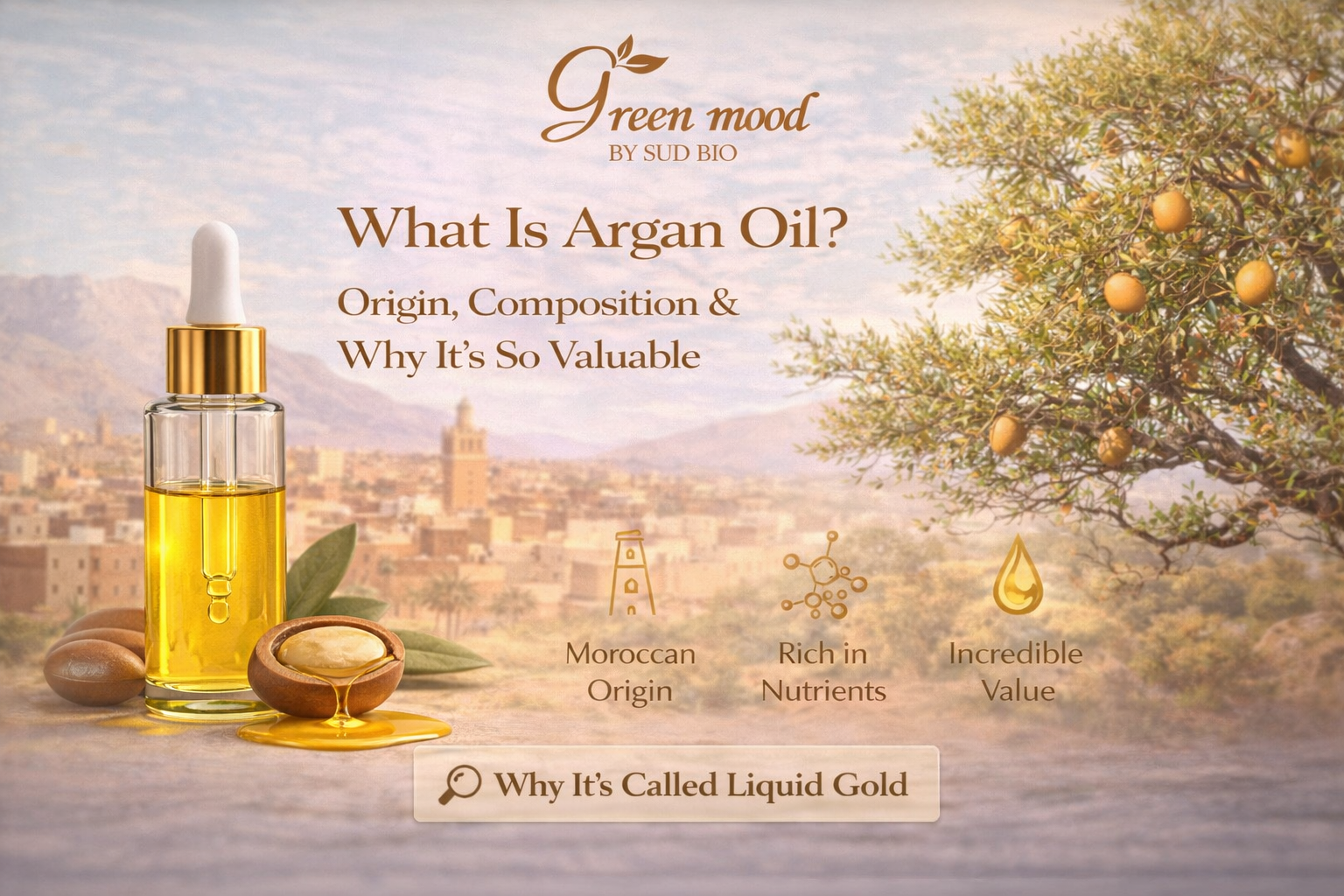
Argan oil is the golden oil pressed from the kernels of the Argan tree, which grows only in south-western Morocco. What it is made from, what is in it, what it is good for and how to tell a real Argan oil from a blend; explained by native of the land with botanical and kernel oils expertise.
Argan oil is a plant oil extracted from the kernels inside the nut of the argan tree (Argania spinosa), a tree native to south-western Morocco. It is cold-pressed, golden in colour, and comes in two forms: a cosmetic oil for skin, hair and nails, and a culinary oil pressed from roasted kernels. On an ingredient list it appears as Argania spinosa kernel oil.
This guide covers what argan oil is and what the name means, what it is made from, where it comes from, how it is produced and why it costs what it costs, what it contains, the difference between cosmetic and culinary argan oil, what it is good for, and how to recognise the real thing. Everything below is written from the point of view of the argan oil Green Mood produces: cold-pressed, unrefined, single-ingredient. For the full list of benefits, see the guide to argan oil benefits and uses; for doses and methods, how to use argan oil.
Quick answer
Argan oil is the extract pressed from the kernels of the argan tree, Argania spinosa, which grows almost only in south-western Morocco. Each fruit holds a hard nut, while each nut contains one to three small kernels, and half those kernels are the origin of Pure Argan Oil. Pressed raw, they provide cosmetic argan oil for the face, body, hair and nails; roasted first, you get the delicious and nutty culinary argan oil. The oil is mostly oleic and linoleic acid, with vitamin E, and it is light enough to absorb in a few minutes. Two things separate real argan oil from the rest: a single ingredient on the label, and cold pressing without refining.
194 MAD–281 MADPrice range: 194 MAD through 281 MAD
What Is Argan Oil?
Argan oil is a vegetable oil, in the same broad family of products as olive, almond or jojoba oil, with one difference that explains most of its reputation: the tree it comes from grows in one corner of the world. Argania spinosa is native to the semi-arid plains and foothills of south-western Morocco, between Essaouira, Agadir and the Anti-Atlas, and almost all the argan oil sold anywhere is pressed from fruit gathered there.
In practical terms it is a light, golden, fast-absorbing oil with a faint nutty smell. On a cosmetic label it appears under its INCI name, Argania spinosa kernel oil, and a pure argan oil lists that and nothing else. It has been part of daily life in the Souss region for generations, as a food and as a skin and hair oil, and since the early 2000s it has become one of the most widely used plant oils in skincare and haircare around the world.
Light and nutty, fading within minutes on the skin (cosmetic); toasted hazelnut (culinary)
Texture
Light; absorbs in a few minutes
Main fatty acids
Oleic acid about 45%, linoleic acid about 33%
Other compounds
Vitamin E (tocopherols), squalene, plant sterols, polyphenols
Name on a label (INCI)
Argania spinosa kernel oil
Two types
Cosmetic, from raw kernels; culinary, from roasted kernels
What “argan” means, and what the oil is called in other languages
Argan is the name of the tree. The word comes from Tashelhit, the Amazigh language spoken in the Souss, and it passed unchanged into Arabic, French and English. “Argan oil” therefore means, quite literally, the oil of the argan tree. The same oil goes by a few names depending on the language and the label:
Language
Name
English
Argan oil
French
Huile d’argan (also written huile d’argane)
German
Arganöl
Spanish
Aceite de argán
Arabic
زيت الأركان (zayt al-argan)
Urdu
آرگن کا تیل (argan ka tel)
Hindi
आर्गन का तेल (argan ka tel)
Ingredient lists (INCI)
Argania spinosa kernel oil
So “huile d’argan” in English is simply argan oil. The name is also often typed as “argon oil”, “organ oil” or “aragan oil”. These are spelling slips, not different products: argon is a gas, and has nothing to do with it. The “Moroccan oil” confusion is explained in a separate question, answered further down.
What Is Argan Oil Made From?
Argan oil is made from one thing: the kernels of the argan fruit. Nothing is added, and no other part of the tree is pressed. The fruit looks like a large olive, green at first and yellow-brown when ripe, and it has three layers.
The pulp. The fleshy outer layer, which dries on the branch or on the ground. It is not pressed for oil; it goes to livestock as fodder.
The nut. A very hard shell under the pulp, harder than a hazelnut shell. It is cracked open to reach the kernels, and the broken shells are burned as fuel.
The kernels. One to three small, almond-shaped seeds inside each nut. They are about half oil by weight, and they are the only part that goes into the press.
The yield is low. The United Nations puts it at about 150 kg of fruit for three litres of oil, so roughly 50 kg of fruit for a single litre.
What comes out of the press depends on one decision taken before pressing: raw kernels give cosmetic argan oil, roasted kernels give culinary argan oil. Both are argan oil, derived from the same kernels; the difference is set out in the section on the two types.
Is argan oil a nut oil?
Botanically, the argan fruit is a drupe, like an olive or a peach, and the oil comes from the seed inside its stone. That makes it closer to a seed oil than to a true nut oil. In everyday language the stone is still called a nut, and people with a tree nut allergy should treat argan oil with the same caution they give other nut oils: reactions are uncommon, but they have been reported.
Where Does Argan Oil Come From?
Argan oil comes from Morocco. The argan tree grows wild across more than 800,000 hectares of the south-west of the country, in an arc that runs from the Atlantic coast around Essaouira and Agadir, across the Souss plain, to Taroudant, Tiznit and Sidi Ifni, and up the lower slopes of the Anti-Atlas. A few small stands exist across the border in the Tindouf area of Algeria, and trial plantations have been set up in other dry countries, but the argan forest of Morocco is where the oil on the market comes from.
That forest is protected, and its place in Moroccan life is recognised internationally:
1998: UNESCO designates the Arganeraie a Biosphere Reserve.
2014: the practices and know-how linked to the argan tree are inscribed on UNESCO’s Representative List of the Intangible Cultural Heritage of Humanity.
2021: the United Nations General Assembly proclaims 10 May the International Day of Argania.
Argan oil also carries a protected geographical indication, the first granted to an African product.
The argan tree, and what it does for the region
The argan tree is a thorny evergreen that reaches eight to ten metres and can live for around two hundred years. Its roots go deep enough to find water where little else grows, which is why it holds the soil of the Souss in place and slows the advance of the desert. Beyond the oil, the tree gives shade and forage for herds, fuel from the cracked shells, and an income for the women’s cooperatives that process the nuts. The benefits of the argan tree are as much ecological and economic as cosmetic.
The well-known photographs of goats standing in argan trees are real: the goats climb for the fruit. The story that argan oil is pressed from nuts the goats have eaten is not how cosmetic argan oil is produced today. The fruit is gathered by hand from the ground.
Argan oil, Moroccan argan oil and “Moroccan oil”: are they the same?
“Moroccan argan oil”, “argan oil of Morocco” and “Morocco argan oil” all describe the same thing as “argan oil”, since Morocco is where it comes from. On a bottle of pure argan oil from Morocco, those words are simply a statement of origin.
The same words on a shampoo, a conditioner or a hair serum usually mean something else: a formula that contains some argan oil among many other ingredients, often silicones and fragrance. “Moroccan oil” in particular is widely used as a product name for hair serums of that kind. There is nothing wrong with them, but they are not argan oil. The ingredient list settles it: a pure argan oil lists Argania spinosa kernel oil and nothing else.
How Argan Oil Is Made
The first steps have changed very little, and the last ones a great deal. Gathering and cracking are still done by hand; pressing is now mechanical.
Harvest. The fruit ripens and falls in summer, and is gathered from the ground.
Drying. The fruit is spread in the sun for a few weeks until the pulp is dry.
Pulping. The dried pulp is removed to free the nut.
Cracking. Each nut is cracked by hand between two stones to release the kernels. Machines tend to crush the kernel along with the shell, so this remains the slowest step.
Sorting, and roasting for the culinary oil. Kernels are sorted. For culinary oil they are lightly roasted; for cosmetic oil they stay raw.
Cold pressing. A mechanical press extracts the oil without added heat and without solvent.
Decanting and filtering. The oil rests, is filtered, and is bottled, ideally in dark glass.
The step-by-step detail, including the traditional stone-mill method, is in how argan oil is made.
Why Argan Oil Is Called Liquid Gold
The nickname “liquid gold” has two sources: the colour of the oil, and what it costs to make. The steps above explain the second.
One region. The tree grows wild in a single part of one country, and the forest cannot be scaled up quickly: an argan tree takes years to bear fruit.
A low yield. Roughly 50 kg of fruit for one litre of oil.
Hand work. Every nut is cracked by hand, and producing a litre takes many hours of cracking alone.
Demand. Since the early 2000s, cosmetics makers around the world have been drawing on the same limited supply.
The result is one of the more expensive plant oils on the market, and the reason a very cheap “argan oil” deserves suspicion: at that price it is diluted, refined, or not argan at all. The full breakdown of the price is in why argan oil is so expensive.
What Argan Oil Contains
Argan oil is about 99% fatty acids, bound up as triglycerides, and about 1% other compounds. That small fraction accounts for much of its character.
Component
Typical share
What it does on skin and hair
Oleic acid (omega-9)
43–49%
Softens, and helps the oil spread and absorb
Linoleic acid (omega-6)
29–36%
A fatty acid the skin barrier uses and the body cannot make
Palmitic acid
11–15%
Gives the oil body and a protective feel
Stearic acid
4–7%
Adds cushioning
Vitamin E (tocopherols)
About 60–90 mg per 100 g
Antioxidant: protects the oil itself and helps skin withstand oxidative stress
Squalene
About 0.3%
A lipid also found in human sebum
Plant sterols (schottenol, spinasterol)
About 0.2%
Support the comfort of the skin barrier
Polyphenols and carotenoids
Traces
Antioxidants; carotenoids give the golden colour
Three things follow from this profile. The balance of oleic and linoleic acid is close to the lipids of the skin’s own surface, which is why argan oil is absorbed instead of sitting on top. The share of linoleic acid is higher than in olive oil and far higher than in coconut oil, which is part of why it suits oily and blemish-prone skin better than those oils do; the comparison is in argan oil vs coconut oil. And the vitamin E content makes it a stable oil with a reasonable shelf life.
Refining removes part of the vitamin E, the sterols and the polyphenols. That is the practical reason to look for an unrefined oil, and it is why Green Mood’s Pure Argan Oil is left unrefined.
Types of Argan Oil: Cosmetic and Culinary
There are two argan oils. They are made from the same kernels and separated by a single step.
Criterion
Cosmetic argan oil
Culinary argan oil
Kernels
Raw
Lightly roasted before pressing
Colour
Golden yellow
Deeper amber
Smell and taste
Light and nutty; fades on the skin
Toasted hazelnut, pronounced
Used for
Face, body, hair, nails, beard
Finishing dishes, dipping, amlou
Sold as
A skincare product, with an INCI list
A food, with food labelling
Cosmetic argan oil is the one meant by almost every skincare and haircare article, including this one. It is cold-pressed from raw kernels, so nothing in it has been altered by heat.
Culinary argan oil is pressed from kernels that have been roasted for a few minutes, which gives it its hazelnut taste. In Morocco it is drizzled over couscous, tagines and salads, eaten with bread at breakfast, and mixed with ground almonds and honey to make amlou. It is a finishing oil, added at the end and kept away from high heat. Green Mood makes one: culinary argan oil.
The two are not interchangeable in practice. Culinary oil on the skin does no harm but smells of toasted nuts; cosmetic oil is not bottled or labelled as a food, and is not meant to be eaten.
Refined, deodorised, blended and scented argan oils
Within cosmetic argan oil there are further grades, and they do not behave alike.
Unrefined (virgin). Pressed and filtered, nothing more. This is the reference grade.
Refined or deodorised. Processed to remove colour and smell, which also removes part of what makes the oil useful.
Blends. Argan oil mixed with cheaper oils or silicones. The front of the pack may still say “argan oil”; the ingredient list says otherwise.
Scented argan oils. Pure argan oil with an added fragrance, made for body, hair and massage. Green Mood’s come in orchid, musk, hibiscus and orange blossom. For the face, the unscented pure oil is the one to use.
What Is Argan Oil Good For?
Argan oil is good for keeping skin, hair and nails supplied with lipids: it softens, limits water loss, adds shine, and makes dry or rough surfaces comfortable again. It is used as a face oil, a body oil and a hair oil, and in its culinary form as a food. The main uses are below, each with its dedicated guide; the complete list is in the guide to argan oil benefits.
On the face
Two to three drops pressed onto damp skin after cleansing work as a serum in the morning or as the last step in the evening. Skin feels softer and less tight from the first application, and fine dehydration lines look less marked over a few weeks. Oily skin uses a single drop. The methods and doses are in argan oil for face; blemish-prone skin has its own guide, argan oil for acne.
On the body
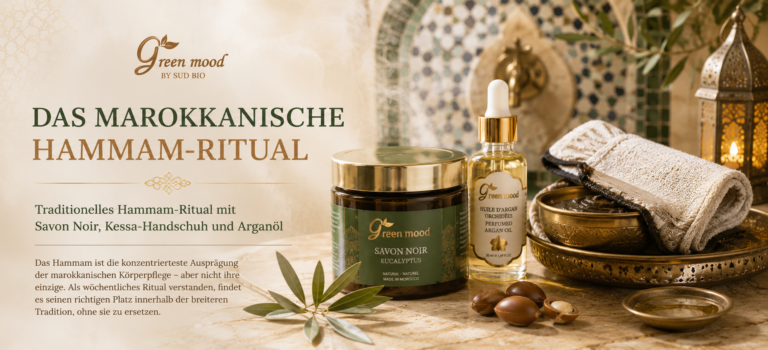
Applied to damp skin after a shower, argan oil replaces or completes a body lotion, and it is the traditional last step after the hammam. It earns its keep on elbows, knees, heels and hands. See argan oil for skin.
On hair and scalp
Two to four drops smoothed through the lengths tame frizz and add shine. A few teaspoons left on for thirty minutes before shampoo work as a mask, and five to eight drops massaged into the scalp ease dryness. Argan oil coats and protects the hair fibre; it does not make hair grow. See argan oil for hair.
On nails, cuticles, lips and beard
A drop massaged into the cuticles softens them and keeps nails from drying out. The same drop works on dry lips and through a beard.
In the kitchen
The culinary oil is used as a finishing oil, for its taste first. Its fatty-acid profile is close to that of olive oil, with a larger share of linoleic acid.
What argan oil is used for, at a glance
Use
Amount
When
Face serum
2–3 drops (1 for oily skin)
On damp skin, morning or evening, before sunscreen
Argan oil does not regrow hair, remove scars, stretch marks or dark spots, treat acne, or protect from the sun. It is a very good lipid layer, and that is the honest extent of it. Sunscreen still goes on top in the morning.
Two cautions. Anyone with a tree nut allergy should patch-test before use. And small, uniform, itchy bumps on the forehead, chest or back may be fungal acne, which plant oils, argan included, tend to aggravate; the argan oil for acne guide explains how to tell the difference.
Common Misconceptions About Argan Oil
“All argan oil is the same”
It is not. Raw or roasted kernels, refined or unrefined, pure or blended: four bottles with the same name on the front can behave in four different ways.
“Argan oil is greasy”
Pure argan oil absorbs in a few minutes at the right dose. A greasy film means too much oil, oil applied to a dry face, or a blend.
“Argan oil clogs pores”
It is listed at 0 on the commonly used comedogenic scales, which are a rough guide, and it rarely congests skin at one to two drops. The full answer, including the cases where it does cause breakouts, is in the section on whether argan oil clogs pores.
Sometimes. Often it is a hair serum that contains a little of it. The ingredient list tells you which.
“The darker the oil, the better”
Darker usually means roasted, which is the culinary oil. Cosmetic argan oil is golden yellow, and the shade varies a little from one batch to the next.
“Real argan oil has no smell”
The opposite. Unrefined argan oil has a light nutty scent that fades on the skin. No smell at all usually means the oil has been deodorised.
“Argan oil makes hair grow”
No oil does. Argan oil protects the hair you have, which means less breakage and lengths that look healthier over time.
How to Recognise Real Argan Oil
Any formula can carry the words “argan oil” on the front of the pack, so the checks are on the back and in the bottle. Five to make before buying, and one at home.
One ingredient. The list reads Argania spinosa kernel oil, and nothing else. No fragrance, no carrier oil, no preservative.
Cold-pressed and unrefined. Both words should be stated on the label.
Organic certification. A recognised certification, such as USDA Organic or CCPB, covers how the kernels were grown and how the oil was processed. What the labels mean is explained in the organic argan oil guide.
Moroccan origin, stated. The tree grows almost only there, so a vague or missing origin is a warning sign.
Dark glass and a date. Light and heat degrade the oil. The bottle should protect it, and a batch or best-before date should be printed.
The sensory check. Golden yellow; a light nutty smell that fades within minutes; absorbed without a film. A perfumed smell means added fragrance, no smell at all usually means refined, and an oil that sits on the surface is likely a blend.
Keep the bottle closed, in a cupboard, away from heat and direct light. Stored that way, cosmetic argan oil keeps for around two years from pressing; once opened, aim to finish it within about a year. An oil that has turned smells sharp, a little like old paint, and should be replaced. The culinary oil follows the best-before date on its label.
The Green Mood Standard
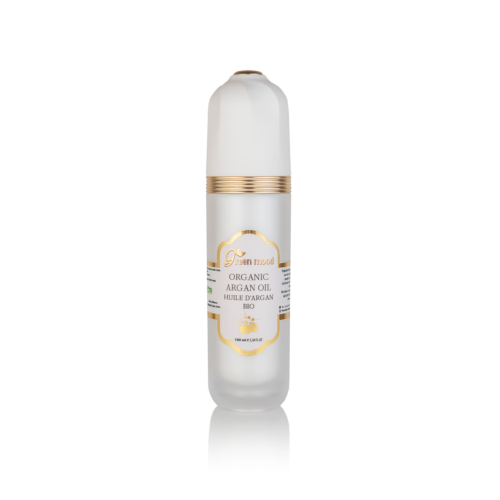
Green Mood is a Moroccan skincare brand based in Casablanca, and its Pure Argan Oil is the oil this guide is written around:
Cold-pressed from certified organic argan kernels
A single ingredient: Argania spinosa kernel oil, nothing added
Unrefined, so the fatty acids and vitamin E described above are intact
Unscented, which is the version to use on the face
Organic certification: USDA Organic and CCPB
Produced in Morocco, in an ISO 22716-certified unit in the Souss-Massa region
Sold online with worldwide shipping, and in seven boutiques, including three airport stores in Casablanca, Agadir and Marrakech
Argan oil is a plant oil pressed from the kernels of the argan tree, which grows in south-western Morocco. It is golden, light and fast-absorbing, and it is used on the face, body, hair and nails. A second version, pressed from roasted kernels, is used as a food.
What is argan oil made from?
From the kernels found inside the hard nut of the argan fruit, and from nothing else. Each nut holds one to three kernels, which are about half oil. The pulp and the shell are not pressed. A pure argan oil therefore has one ingredient: Argania spinosa kernel oil.
Where does argan oil come from?
From Morocco. The argan tree grows wild in the south-west of the country, around Essaouira, Agadir, Taroudant, Tiznit and Sidi Ifni, in a forest that UNESCO designated a Biosphere Reserve in 1998. Small stands exist in neighbouring Algeria, but the oil on the market is Moroccan.
What is argan oil good for?
It is good for dry or tight skin, dry lengths and ends, frizz, brittle nails and rough cuticles. It supplies lipids, limits water loss and adds softness and shine. It does not treat acne, regrow hair, remove scars or replace sunscreen.
What is argan oil used for?
As a face serum or night oil (two to three drops), a body oil after the shower, a leave-in for hair lengths (two to four drops), a pre-shampoo hair mask, a scalp massage oil, and a cuticle and beard oil. The culinary version is used as a finishing oil on food.
Is argan oil the same as Moroccan oil?
Not necessarily. Pure argan oil comes from Morocco, so “Moroccan argan oil” and “argan oil of Morocco” on a bottle of pure oil mean the same thing. “Moroccan oil” on a hair serum or a shampoo usually refers to a formula that contains some argan oil along with silicones and fragrance. Check the ingredient list: pure argan oil lists Argania spinosa kernel oil only.
Is it argan oil, argon oil or organ oil?
Argan oil. “Argon oil”, “organ oil” and “aragan oil” are common misspellings of the same word. Argon is a gas and has no connection to the oil, and there is no cosmetic product called organ oil.
What is “huile d’argan” in English?
Argan oil. “Huile d’argan” is the French name, “Arganöl” the German one and “aceite de argán” the Spanish one. On ingredient lists in every country the oil carries the same name: Argania spinosa kernel oil.
What does argan oil smell like?
Unrefined cosmetic argan oil has a light, slightly nutty smell that fades within a few minutes on the skin. Culinary argan oil smells and tastes of toasted hazelnut. A cosmetic argan oil with no smell at all has usually been deodorised, and one that smells perfumed has had fragrance added.
Is argan oil a nut oil, and is it safe with a nut allergy?
The argan fruit is a drupe and the oil comes from its seed, so botanically it is closer to a seed oil. Reactions are uncommon but have been reported. With a tree nut allergy, patch-test on the inner arm before skin use, and ask an allergist before eating the culinary oil.
Can you eat argan oil?
The culinary oil, yes: it is pressed from roasted kernels and sold as a food, used as a finishing oil on couscous, salads and bread, and in amlou. Cosmetic argan oil is not labelled or sold as a food, and is not meant to be eaten.
Why is argan oil so expensive?
The tree grows in one region, the yield is low at roughly 50 kg of fruit per litre, and every nut is cracked by hand. An argan oil sold very cheaply is usually diluted, refined, or not argan oil.
Does argan oil clog pores?
Rarely, when the oil is pure and the dose is one to two drops. It is listed at 0 on the common comedogenic scales, which are a rough guide. Congestion usually comes from using too much, applying it over sunscreen or makeup, or using a blend.
Does argan oil reduce sebum on oily skin?
It does not change how much sebum the skin makes, which is set largely by hormones. What one drop on damp skin does is keep the surface hydrated, so the skin is less stripped and looks less shiny through the day.
How long does argan oil last?
Around two years from pressing when the bottle is kept closed, away from heat and light, and about a year once opened. A sharp smell, like old paint, means the oil has turned.
194 MAD–281 MADPrice range: 194 MAD through 281 MAD
The Bottom Line
Argan oil is the cold-pressed oil of the argan kernel, from a tree that grows in south-western Morocco and almost nowhere else. It is mostly oleic and linoleic acid with vitamin E, light enough for the face and useful from scalp to cuticles. Whether a bottle lives up to that comes down to four things on its label: one ingredient, cold-pressed, unrefined, origin stated.
Green Mood produces its argan oil in Morocco, in an ISO 22716-certified unit in the Souss-Massa region. The pure argan oil this guide is written around is the place to start.