🌍 Free shipping above 150 € worldwide.


Argan Oil vs Castor Oil: Which Is Better for Hair Growth, Hair and Skin?
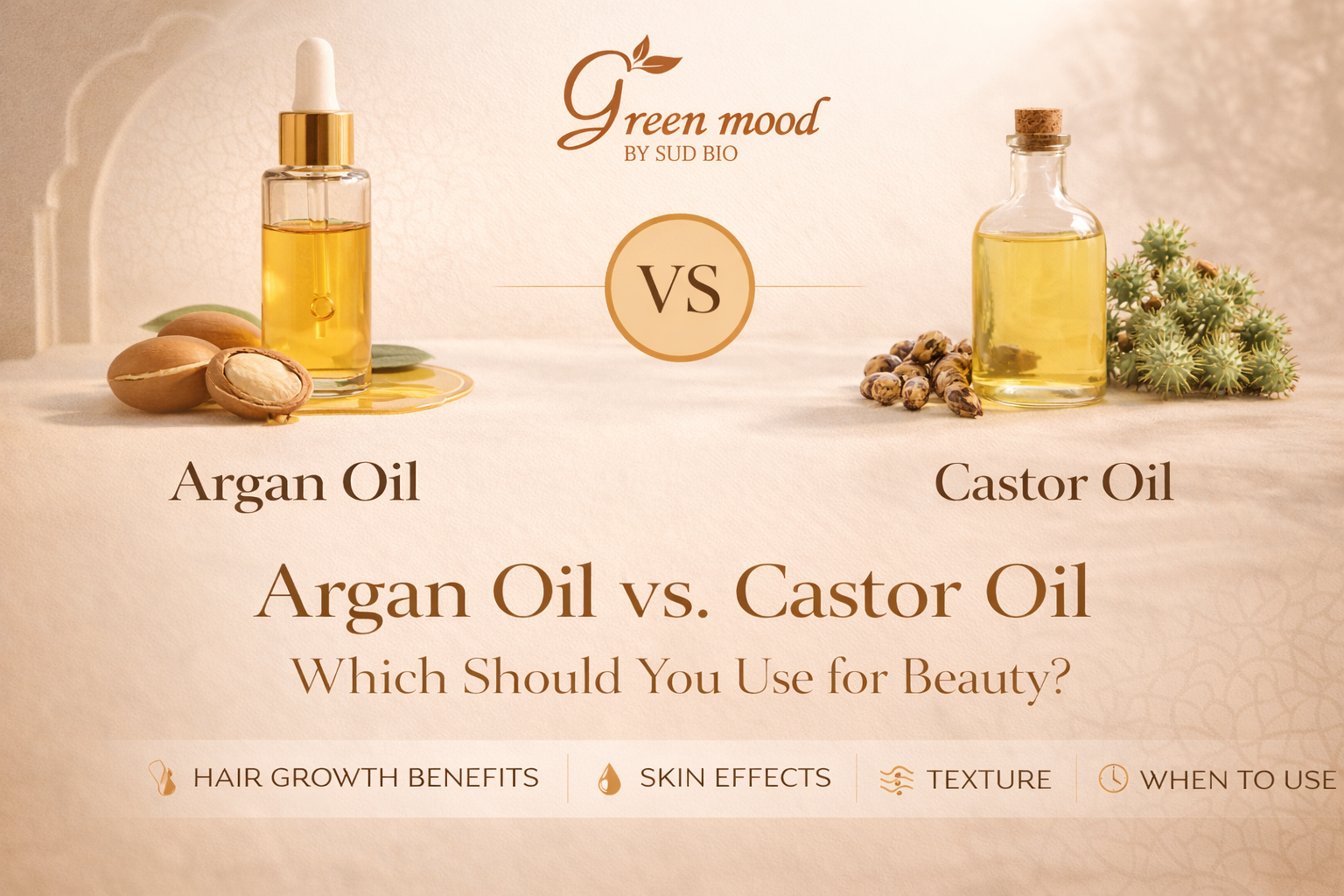
Argan oil and castor oil get compared constantly and are almost never interchangeable. One is a light, fast-absorbing finishing oil that belongs on the face and on hair every day; the other is a thick, tacky, ricinoleic-acid oil that belongs in rinse-off treatments and on eyebrows. The comparison is worth making not to pick one over the other but to stop people using the wrong one for the job — which is where most castor-oil disappointments and most “argan oil did nothing” complaints come from.
This guide sets the two oils side by side on composition, texture, hair (including the hair-growth question, answered on the evidence rather than the folklore), skin, mixing ratios and cost, then gives a plain decision table. The argan side is written for the grade of oil Green Mood produces — cold-pressed, unrefined, single-ingredient. For the full argan hair routine, see argan oil for hair; for the face, argan oil for face.
Quick answer
Argan oil for daily hair care, frizz, shine, heat styling and anything on the face. Castor oil for rinse-off scalp masks, eyebrows and lashes, cuticles and very dry patches — never as a leave-in on hair lengths and never on the face. Neither oil makes hair grow faster: castor’s reputation for growth rests on a laboratory hypothesis, not on trials in people. What castor does is coat and thicken; what argan does is smooth, protect and reduce breakage, which is how hair keeps the length it grows. The two mix well for scalp treatments at roughly one part castor to two or three parts argan.
Argan Oil vs Castor Oil at a Glance
| Argan oil | Castor oil | |
|---|---|---|
| Source | Kernels of Argania spinosa, southwestern Morocco only | Seeds of Ricinus communis, mostly India and Brazil |
| Main fatty acids | ~45% oleic, ~33% linoleic, ~12% palmitic | ~85–90% ricinoleic (a hydroxylated fatty acid found in almost no other oil) |
| Texture | Light, fluid, dry-touch | Very thick, viscous, tacky — roughly twenty times the viscosity of argan |
| Absorption | Minutes | Barely; sits on the surface |
| Finish on hair | Shine, smoothness, no weight at 2–4 drops | Heavy coating, dull, weighs lengths down |
| Best hair use | Daily leave-in, frizz, heat styling, oil bath | Rinse-off scalp mask, brows, lashes, beard ends |
| Face | Yes — all skin types at 1–3 drops | No as a leave-on; yes as a rinse-off cleansing oil |
| Congestion tendency | Low | Low on rating lists, but occlusive and hard to remove |
| Antioxidants | High: tocopherols (vitamin E), sterols, squalene, polyphenols | Low |
| Shelf life once opened | 12–24 months, dark bottle | Two years or more; very stable |
| Cost per 100 ml | High — a labour-intensive, single-region oil | Low — a bulk industrial crop |
What Each Oil Is
Argan oil
Argan oil is pressed from the kernels inside the fruit of the argan tree, which grows almost exclusively in southwestern Morocco. Its fatty acid profile is about 80% unsaturated — mostly oleic and linoleic — which is close to the lipids on healthy skin and hair fibre and is why it absorbs rather than coats. It is also one of the richer plant oils in vitamin E (tocopherols in the region of 60 to 90 mg per 100 g) and carries plant sterols, squalene and polyphenols. The result is an oil that behaves like a serum: light, fast-absorbing, protective. Its limitation is exactly that lightness — it will not hold eyebrow hairs in place or seal a cracked heel. For the full picture, see the complete argan oil guide.
Castor oil
Castor oil is pressed from the seeds of the castor plant, a bulk crop grown mainly in India. Chemically it is unusual: 85 to 90% of it is ricinoleic acid, a fatty acid with an extra hydroxyl group that makes the oil extremely viscous, slightly water-attracting and very slow to oxidise. That structure explains everything castor oil is used for — it grips, it coats, it stays put — and everything it is bad at: it does not absorb, it is difficult to spread, and it is hard to wash out. The seeds contain the toxin ricin, but ricin is a water-soluble protein that stays in the seed mash and is not present in properly processed cosmetic castor oil. Castor oil is not Moroccan and is not something Green Mood produces; it is included here because it is the oil argan is most often compared with for hair.
-
 Best SellerPure Botanical
Pure Argan Oil
Price range: 194 MAD through 281 MAD
Argan Oil vs Castor Oil for Hair
Most people arrive at this comparison because of one claim: castor oil grows hair. It is worth dealing with that first, because the answer decides how the rest of the comparison should be read.
Hair growth: what the evidence says
There is no clinical trial in people showing that castor oil increases the rate of hair growth or the number of growing follicles. The mechanism usually cited — that ricinoleic acid inhibits an enzyme linked to a prostaglandin found at high levels on balding scalps — comes from computer modelling and laboratory work, not from anyone’s head. Argan oil has no growth-stimulating evidence either, and no honest guide should claim otherwise for either oil. What both oils can do is indirect, and here they differ:
- Castor oil coats. A thick film around each strand makes hair look and feel denser, and a coated strand breaks less when brushed. Hair does not grow faster; more of what grows survives, and it looks thicker while the oil is on it. The effect is cosmetic and washes out.
- Argan oil smooths and protects. It fills gaps in a lifted cuticle, reduces friction, limits heat and oxidative damage, and cuts breakage — the main reason people feel their hair “will not grow past” a certain length. The effect is smaller per application but builds with daily use, because argan can be worn daily and castor cannot.
For hair that is thinning rather than breaking, neither oil is the tool. That needs a scalp-targeted formula and, if it is hereditary, a dermatologist; the argan oil for hair guide covers where oil ends and treatment begins.
Daily use, shine and frizz
Argan, without qualification. Two to four drops on the mid-lengths and ends of damp or dry hair give shine, calm frizz and ease detangling, and the hair stays light. Castor oil on lengths as a leave-in weighs hair flat, dulls it and attracts dust; it is also the only common cosmetic oil with published case reports of acute hair matting — long or damaged hair applied with undiluted castor oil, left in, and felting into a mass that had to be cut out. That is rare, but it is a real risk with a specific cause: viscosity plus long lengths plus leaving it in.
Scalp
Both work, differently. Argan oil suits regular scalp care — a weekly massage with five to eight drops, left twenty to thirty minutes and washed out — because it spreads easily and rinses cleanly. Castor oil suits an occasional intensive scalp mask on a dry, flaky or tight scalp: its film holds moisture in and its ricinoleic acid has some laboratory evidence of calming inflammation. Used neat it is a chore to wash out; mixed with argan it becomes workable (ratios below). Oily scalps should keep castor oil off entirely.
Eyebrows, lashes and beard
This is castor oil’s strongest case. Brow and lash hairs are short and coarse, and a thick oil that grips them and darkens them slightly makes brows look fuller immediately — again cosmetic, again with no growth evidence, and again the only oil that does it well. A drop on a clean spoolie at night, kept out of the eye itself. For the beard, split the job: castor on the ends of a coarse beard for control and the appearance of density; argan on the skin under the beard and on the whole beard daily for softness and to stop the flaking that a beard hides. Castor oil on beard skin daily will congest it.
Heat styling and colour-treated hair
Argan. Applied to damp mid-lengths before blow-drying, it forms a thin lipid layer that limits the sudden dehydration of hot air and helps the cuticle stay flat; on bleached or coloured hair it reduces the roughness that makes strands catch and snap. Castor oil under heat sits on the surface and cooks; it has no place in a styling routine.
Argan Oil vs Castor Oil for Skin
Face
Argan, for every skin type, at one to three drops on damp skin. It absorbs in minutes, is listed at 0 on the comedogenic rating lists, and suits oily and acne-prone faces as well as dry ones — see argan oil for oily skin and argan oil for acne. Castor oil is listed at 1 on those same lists, which people read as “safe for the face”; the number misses the point. An oil that does not absorb and cannot be removed without a cleanser is occlusive by behaviour, whatever its rating, and on a face it traps sebum, sweat and whatever is under it. As a leave-on, castor oil belongs on lips, cuticles and cracked heels, not on cheeks.
The one facial use castor oil is right for: oil cleansing
Castor oil dissolves makeup and sunscreen better than most oils, which is why the classic oil-cleansing method uses it — one part castor to three or four parts a lighter oil, massaged onto dry skin, then removed with a warm cloth and followed by a normal cleanser. Argan works as the lighter partner. The key word is “removed”: as a rinse-off, castor is useful on the face; as a leave-on, it is not.
Body, hands and feet
Here the two divide cleanly. Argan oil is the daily body oil: it absorbs, it does not stain clothes, and its antioxidant load has a role on skin that sees sun. Castor oil is the spot treatment for the places nothing else seals — cracked heels overnight under socks, split cuticles, chapped lips, a patch of eczema-prone skin that needs a barrier. Two drops of argan on the whole hand; a fingertip of castor on the cuticles alone.
Sensitive and acne-prone skin
Argan, and not close. A single-ingredient, unscented, fast-absorbing oil is one of the few lipid steps very reactive skin tolerates, and it calms the irritation acne treatments cause. Castor oil’s occlusion and stickiness are the opposite of what inflamed or congested skin needs.
Can You Mix Argan Oil and Castor Oil?
Yes, and for scalp work it is the best way to use castor oil at all: argan thins it to something that spreads and rinses. For lengths, do not bother — castor adds nothing argan is not already doing, and the mix will still weigh hair down. Ratios that work:
| Goal | Ratio (castor : argan) | How to use |
|---|---|---|
| Dry or flaky scalp mask | 1 : 2 | Warm, massage into the scalp, leave 30–60 min, shampoo twice. Weekly at most. |
| Thin or fine hair scalp mask | 1 : 3 | Same method; the lighter mix rinses more easily from fine hair. |
| Beard, coarse and unruly | 1 : 3 | A few drops daily on the beard itself; argan alone on the skin beneath. |
| Oil cleanse (face, rinse-off) | 1 : 3 to 1 : 4 | Massage on dry skin, remove with a warm cloth, follow with cleanser. |
| Brows and lashes | Castor alone | One drop on a clean spoolie at night; argan is too light to hold the hairs. |
| Hair lengths, daily | Argan alone | 2–4 drops on damp or dry mid-lengths and ends. No castor. |
Whichever mix you make, the argan in it should be the pure grade — cold-pressed, unrefined, single-ingredient — because a refined or blended argan oil is heavier and defeats the purpose of thinning castor with it.
Which to Use for What
| You want | Use | Why |
|---|---|---|
| Shine and less frizz every day | Argan | Absorbs, stays light, daily-safe |
| Hair to keep its length | Argan daily; castor scalp mask occasionally | Breakage is the length thief; argan reduces it every day |
| Fuller-looking brows or lashes | Castor | Only a thick oil holds short coarse hairs |
| Heat-styling protection | Argan | Thin lipid film on damp hair; castor cooks on the surface |
| A dry, flaky scalp treatment | Castor + argan, 1 : 2, rinse-off | Castor seals, argan makes it spreadable and rinsable |
| A facial oil | Argan | Absorbs, low congestion tendency, suits all skin types |
| Removing makeup with oil | Castor + argan, 1 : 3, rinse-off | Castor dissolves pigment and sunscreen; argan lightens the mix |
| Cracked heels, cuticles, lips | Castor | Occlusion is the point here |
| Beard softness and beard skin | Argan (castor on the ends only) | Skin under a beard congests under castor |
| Sensitive or acne-prone skin | Argan | Single ingredient, fast-absorbing, calming |
-
Best SellerPure Botanical
Pure Argan Oil
Price range: 194 MAD through 281 MAD
How to Use Each Oil Correctly
Argan oil — the daily routine
- Hair: 2 to 4 drops warmed between the palms, smoothed over damp or dry mid-lengths and ends. Never at the roots as a leave-in. Once a week, a 30- to 60-minute pre-shampoo oil bath on dry lengths for damaged or coloured hair.
- Face: 1 to 3 drops pressed onto damp skin after cleansing, under moisturiser or alone, under SPF in the morning.
- Body: a few drops on damp skin after the shower.
The full method-by-method routine is in how to use argan oil.
Castor oil — the rinse-off treatment
- Mix one part castor with two to three parts argan; warm the mix slightly so it spreads.
- Section the hair and apply to the scalp only with the fingertips. Massage for three to five minutes.
- Leave 30 to 60 minutes under a warm towel. Do not leave overnight on long hair.
- Shampoo twice. The second wash is what removes castor oil; one wash leaves a film.
- Brows and lashes: one drop on a clean spoolie at night, wiped off in the morning.
Once a week is enough; more often builds up on the scalp and makes hair look unwashed.
Common Mistakes
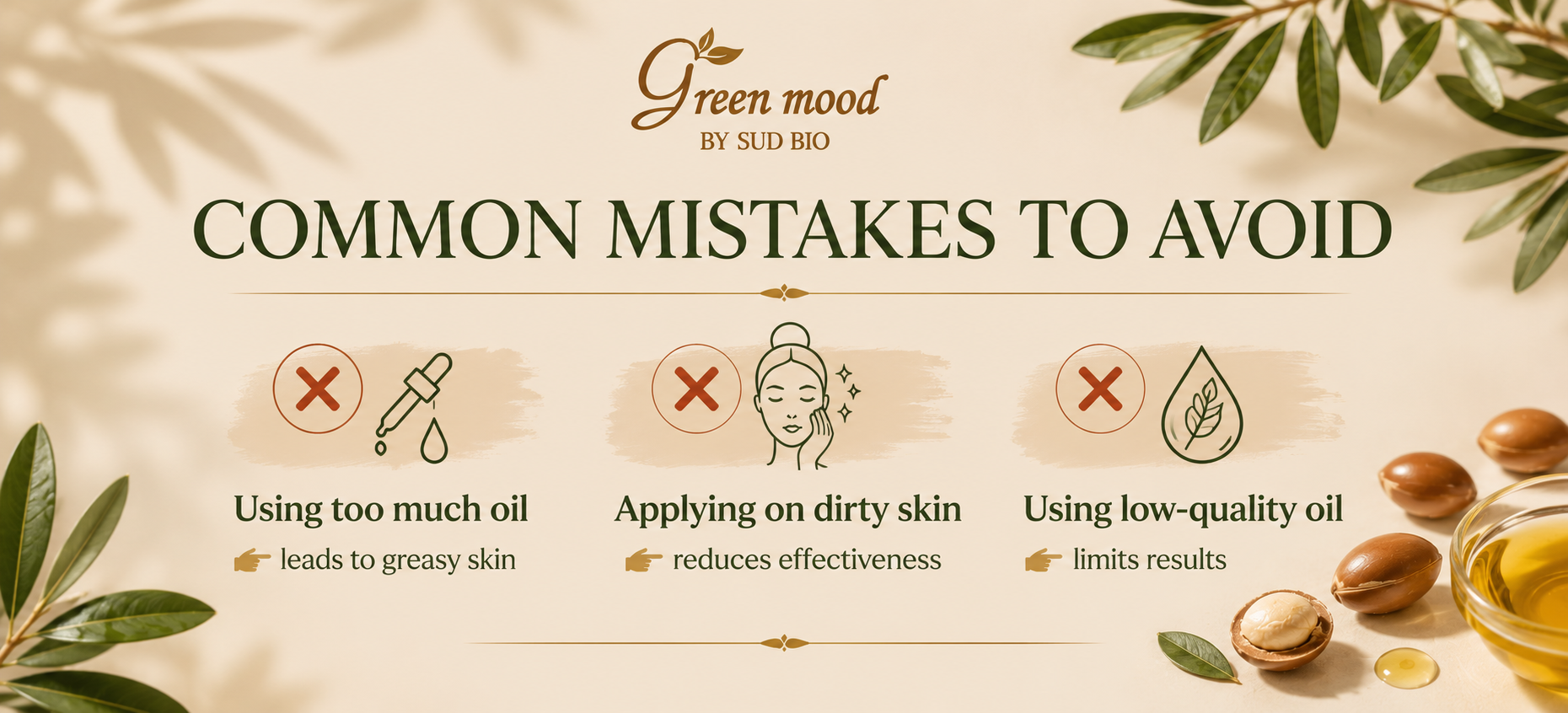
Leaving castor oil in the lengths
The cause of flat, dull, dusty-looking hair and, at the extreme, matting. Castor oil goes on the scalp, brows or beard ends and comes out with a double shampoo. It is never a leave-in.
Using castor oil as a facial oil
A comedogenic rating of 1 does not make an oil that will not absorb suitable for the face. As a rinse-off cleansing oil, yes; as a leave-on, congestion within the week for most skins.
Expecting either oil to grow hair
Neither does. If hair is breaking, argan daily fixes the length problem. If hair is thinning, an oil is not the answer; a scalp-targeted routine is, and hereditary thinning needs a dermatologist.
Using castor oil neat on the scalp
Hard to spread, harder to rinse, and the reason people wash three times and still feel a film. Thin it with argan.
Applying argan oil at the roots
The argan-side mistake. Roots need volume, not lipid. Mid-lengths and ends only as a leave-in; the scalp only as a rinse-off massage.
Buying a blended argan oil for the comparison to hold
Everything above assumes a pure, unrefined argan oil. A refined or silicone-cut “argan” product is heavier, absorbs worse and coats rather than smooths — which turns it into a poor castor oil rather than a good argan oil. Check that the INCI reads Argania spinosa kernel oil and nothing else; see how to recognize pure argan oil.
Choosing Well
Argan oil
- Single ingredient — Argania spinosa kernel oil, nothing added.
- Cold-pressed and unrefined — refining removes part of the vitamin E, sterols and polyphenols and changes the texture.
- Certified organic — USDA Organic, ECOCERT or CCPB confirms the sourcing and processing chain.
- Moroccan origin, stated — the tree grows nowhere else at scale.
- Sensory check — a light nutty aroma that fades on the skin; perfumed means fragrance added, odourless usually means refined.
Castor oil
- Cold-pressed, hexane-free — solvent-extracted castor oil is common and cheaper; the label should say cold-pressed.
- Pale and clear — the standard cosmetic grade. “Jamaican black” castor oil is made from roasted seeds and ash; it is darker and more alkaline, with no evidence it does more for hair.
- Plain — castor oil “hair growth serums” with added fragrance and essential oils cost more and add irritants to a scalp treatment.
The Green Mood Standard
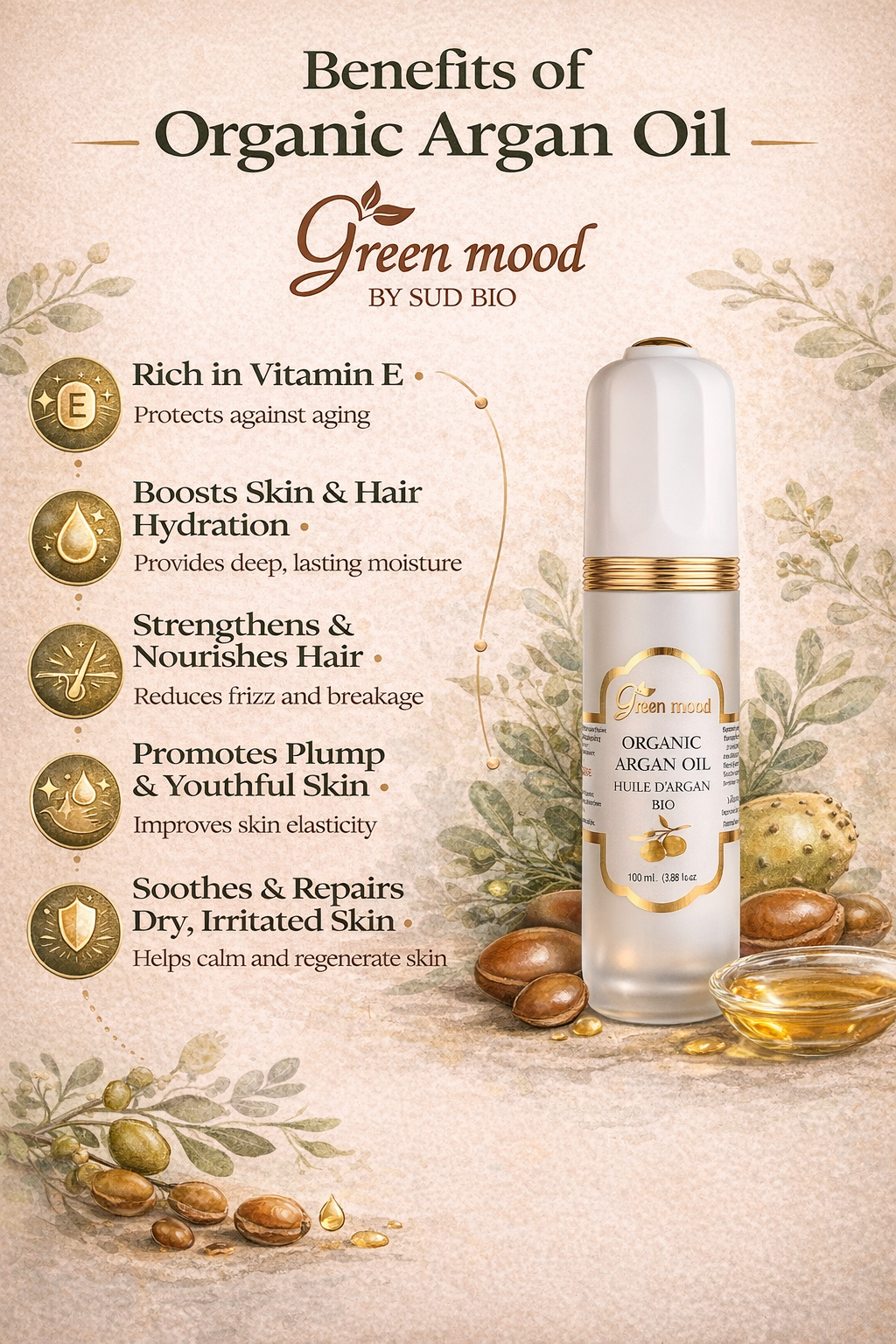
Green Mood’s Pure Argan Oil is the argan side of every comparison in this guide:
- Cold-pressed from certified organic argan kernels
- Single-ingredient — Argania spinosa kernel oil, nothing added
- Unrefined, so the light texture, fatty acid balance and vitamin E content are kept as pressed
- Unscented — the version for face, scalp and sensitive skin
- Certified by USDA Organic, ECOCERT and CCPB
- Produced in Morocco under ISO 22716 cosmetic good manufacturing practice
For hair that is thinning rather than breaking — the case where neither oil is the answer — Green Mood’s anti-hair loss pack pairs an argan-based strengthening shampoo with a scalp routine built for that problem; the argan oil hair mask is the weekly step for lengths that are dry or damaged.
-
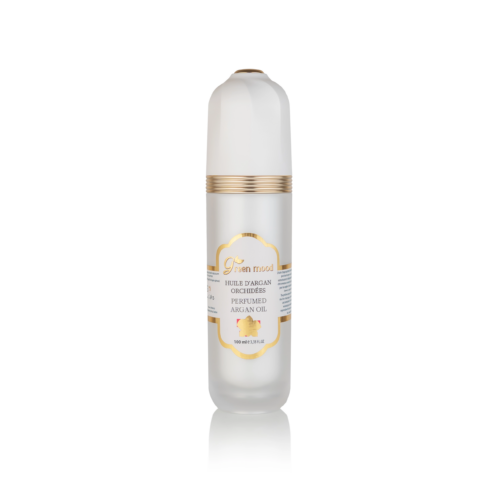 Best SellerSignature Scent
Argan oil with Orchid
Price range: 281 MAD through 378 MAD
Frequently Asked Questions
Is argan oil or castor oil better for hair growth?
Neither makes hair grow faster; there are no trials in people showing that for either oil. Castor oil coats strands so hair looks thicker and breaks less while the oil is on; argan oil smooths and protects the cuticle so hair breaks less every day it is worn. Because argan can be used daily and castor cannot, argan does more for keeping length over months. Thinning hair needs a scalp-targeted routine, not an oil.
Does castor oil really grow hair?
Not on the evidence. The mechanism people cite — ricinoleic acid blocking an enzyme linked to a prostaglandin found on balding scalps — comes from computer modelling and laboratory work, not from studies on people’s heads. What castor oil visibly does is make existing hair look denser by coating it, and reduce breakage while it is in. Both are real, both are cosmetic, both wash out.
Can I mix argan oil and castor oil together?
Yes, and for scalp treatments it is the best way to use castor oil: one part castor to two or three parts argan makes it spreadable and rinsable. Leave 30 to 60 minutes, shampoo twice. For hair lengths, use argan alone — castor adds weight and nothing else. For brows and lashes, castor alone; argan is too light to hold the hairs.
Which is better for the face, argan oil or castor oil?
Argan, for every skin type, at one to three drops on damp skin. Castor oil does not absorb and is hard to remove, which makes it occlusive on a face regardless of its low comedogenic rating. Its one facial use is as a rinse-off cleansing oil mixed with a lighter oil, removed with a warm cloth and followed by a cleanser.
Can castor oil be used on hair every day?
No. As a leave-in on lengths it weighs hair down, dulls it and, on long or damaged hair, carries a small but documented risk of matting. Use it once a week as a scalp mask, thinned with argan, and wash it out with two shampoos. Argan oil is the one that suits daily use.
Argan oil or castor oil for eyebrows and eyelashes?
Castor. Brow and lash hairs are short and coarse, and only a thick oil holds them in place and darkens them enough to look fuller. One drop on a clean spoolie at night, kept out of the eye. Expect a cosmetic effect, not new growth. Argan oil is too light to do this job.
Argan oil or castor oil for a beard?
Argan for the beard itself and the skin under it, daily — it softens the hair and stops the flaking a beard hides. Castor only on the ends of a coarse, unruly beard, a few drops mixed with argan, for control and the look of density. Castor oil on beard skin every day congests it.
Which oil is better for a dry, flaky scalp?
For regular care, argan: five to eight drops massaged in weekly, left 20 to 30 minutes, washed out. For an occasional intensive mask, castor thinned with argan at 1 : 2 — the castor seals moisture in, the argan makes it workable. Oily scalps should skip castor oil altogether.
Will castor oil clog pores?
It is listed at 1 on comedogenic rating lists, which understates the practical risk: an oil that sits on the surface and cannot be removed without a cleanser traps sebum and dead cells under it. As a leave-on facial oil it congests most skins within days. As a rinse-off it is fine. Argan oil, listed at 0 and absorbed in minutes, is the one for the face.
Which oil is better for split ends and breakage?
Argan, daily. Split ends cannot be repaired by any oil, but argan on the mid-lengths and ends reduces the friction and dryness that create new ones, and it can be worn every day. Castor oil reduces breakage while it coats the hair but has to be washed out, so its effect is limited to treatment days.
Is castor oil safe? What about ricin?
Cosmetic castor oil is safe on skin and hair. Ricin is a protein in the seed that stays in the leftover mash when the oil is pressed; it is not present in properly processed castor oil. The practical cautions are different: keep it out of the eyes, patch-test on the inner arm if your skin is reactive, and never leave it in long hair.
Why is argan oil so much more expensive than castor oil?
Castor is a bulk industrial crop pressed at scale; argan grows in one region of Morocco, the kernels are extracted largely by hand from a hard shell, and each litre needs the fruit of several trees. Per use the gap is smaller than per bottle: argan is dosed in drops, and one bottle lasts months on hair and face.
The Bottom Line
Argan oil and castor oil are not rivals; they are different tools. Argan is the daily oil for hair lengths, heat styling, the face and the body — light, absorbed in minutes, and the one that reduces breakage every day it is worn. Castor is the occasional, rinse-off oil for the scalp, the brows and the places that need sealing rather than absorbing. Neither grows hair, and the guide that tells you one does is selling something.
If you own one bottle, own the argan: it covers nine of the ten jobs in the table above. If you want the tenth — brows, lashes, a heavy scalp mask — add castor, and thin it with the argan you already have.