🌍 Free shipping above 150 € worldwide.


Argan Oil vs Coconut Oil: Which Is Better for Hair, Face and Skin?
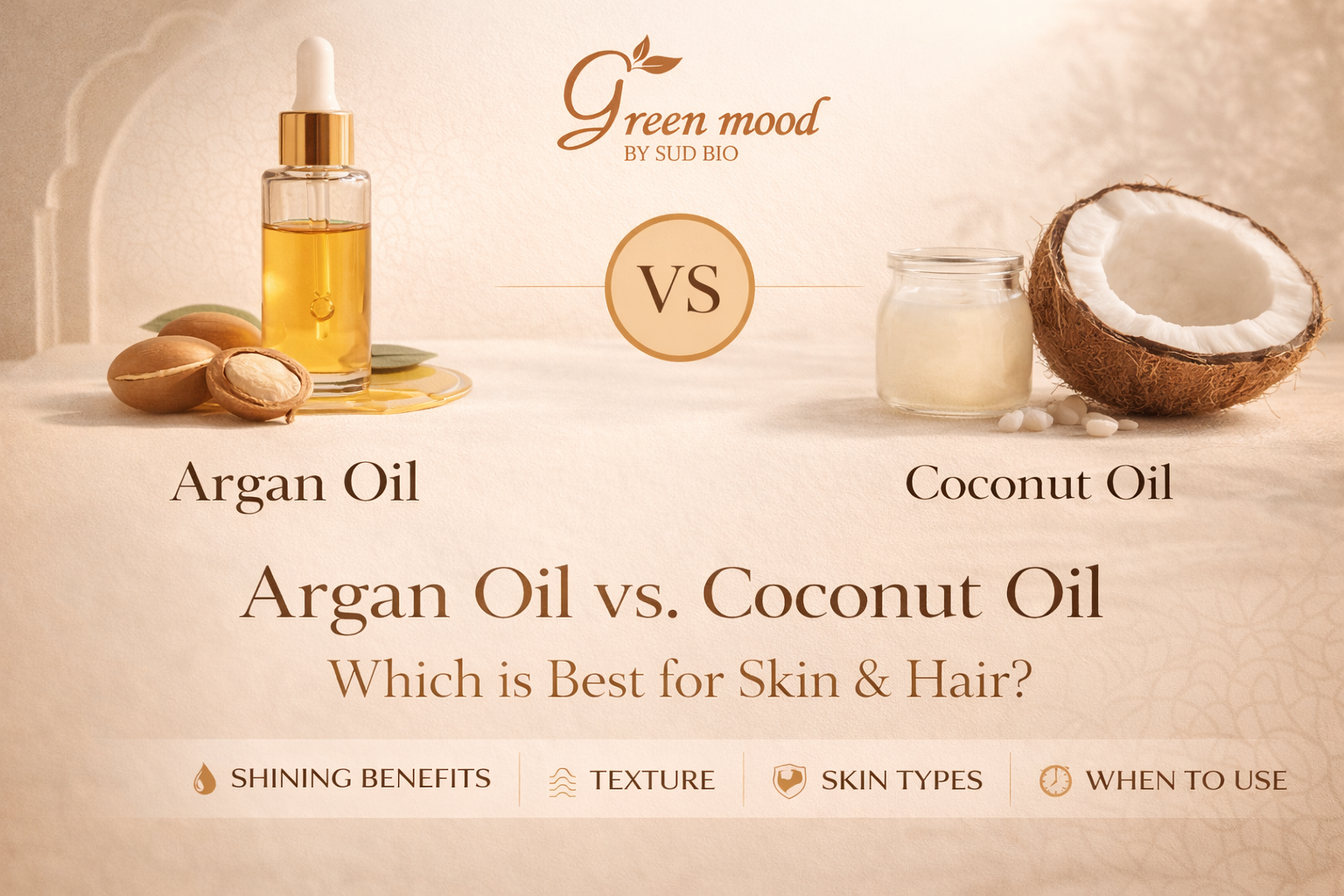
Argan oil and coconut oil are the two plant oils most people have in the house, and they are close to opposites. One is about 80% unsaturated, liquid, light and absorbed in minutes; the other is about 90% saturated, solid below room temperature, and built to coat. That difference decides everything: coconut oil has the best evidence of any oil for stopping protein loss inside the hair fibre, and one of the worst records of any oil for congesting a face. Argan oil is the reverse — the daily face and hair oil, without the deep-treatment power. The useful comparison is not which one is better; it is which one is better for what.
This guide sets the two side by side on composition, texture, hair (with the protein-loss evidence explained rather than waved at), face and body skin, acne-prone and eczema-prone skin, mixing, and cost, and ends with a plain decision table. The argan side is written for the grade of oil Green Mood produces — cold-pressed, unrefined, single-ingredient. For the argan routines in full, see argan oil for hair, argan oil for face and how to use argan oil.
Quick answer
Argan oil for the face, for daily use on hair, for oily and acne-prone skin, and for anything you leave on. Coconut oil for a rinse-off pre-shampoo mask on thick, coarse or damaged hair, and for very dry body skin — never on the face, and never as a daily leave-in. Coconut oil is the one oil shown to reduce protein loss from the hair shaft, which makes it the better deep treatment; argan is the one that can be worn every day without weight, flattening or congestion. On hair that turns stiff or straw-like with coconut oil — common on fine and low-porosity hair — argan is the answer. The two mix well in a mask: two parts argan to one part coconut.
Argan Oil vs Coconut Oil at a Glance
| Argan oil | Coconut oil | |
|---|---|---|
| Source | Kernels of Argania spinosa, southwestern Morocco only | Flesh of the coconut, grown across the tropics |
| Fatty acid profile | ~80% unsaturated: ~45% oleic, ~33% linoleic | ~90% saturated: ~48% lauric, ~18% myristic, ~9% palmitic |
| State at room temperature | Liquid | Solid below about 24 °C, melts on contact with skin |
| Texture and absorption | Light, dry-touch, absorbed in minutes | Rich, slow, leaves a film |
| Penetrates the hair shaft | Partially — sits in and between the outer layers | Yes — lauric acid is small and straight enough to enter the fibre |
| Best hair use | Daily leave-in, frizz, shine, heat styling | Rinse-off pre-shampoo mask, weekly |
| Face | Yes, all skin types, 1–3 drops | No as a leave-on; rinse-off makeup removal only |
| Congestion tendency | Low — listed at 0 on rating lists | High — listed at 4 on the same lists; occlusive by behaviour |
| Body skin | Daily oil on damp skin | Very dry and eczema-prone skin; good evidence as a moisturiser |
| Antioxidants | High: vitamin E, sterols, squalene, polyphenols | Low |
| Shelf life, opened | 12–24 months, dark bottle | Two years or more; very stable |
| Cost per 100 ml | High — single region, hand-cracked kernels | Low — bulk crop |
What Each Oil Is
Argan oil
Argan oil is pressed from the kernels of the argan tree, which grows almost only in southwestern Morocco. About 80% of it is unsaturated fatty acids — oleic and linoleic — which are close to the lipids on healthy skin and hair fibre and explain why it absorbs rather than coats. It carries a high load of vitamin E (in the region of 60 to 90 mg per 100 g), plant sterols, squalene and polyphenols. On skin it behaves like a serum; on hair, like a light finishing oil. Its limitation is that it cannot do what coconut does best: it does not penetrate deep enough into the shaft to change what happens to the hair’s protein when it is washed. For the whole picture, see the complete argan oil guide.
Coconut oil
Coconut oil is pressed from the flesh of the coconut, a bulk crop across the tropics. About 90% of it is saturated fat, and roughly half of that is lauric acid — a short, straight, twelve-carbon fatty acid that can pass into the hair fibre where longer or kinked fatty acids cannot. That is the source of the one thing it does better than any other oil: in a series of studies on damaged and undamaged hair, coconut oil applied before or after washing reduced the loss of protein from the shaft, while mineral oil and sunflower oil did not. It is also a good occlusive on body skin, with clinical evidence as a moisturiser for very dry and eczema-prone skin. The same saturated, film-forming structure makes it one of the most congesting oils on a face and a poor daily leave-in on hair. Unrefined (“virgin”) coconut oil smells of coconut and keeps its minor compounds; refined is nearly odourless with much the same fatty acid profile. Neither is Moroccan, and coconut oil is not something Green Mood produces; it is compared here because it is the oil argan is most often set against.
-
 Best SellerPure Botanical
Pure Argan Oil
Price range: 194 MAD through 281 MAD
Argan Oil vs Coconut Oil for Hair
This is the comparison where coconut oil has a genuine case, so it is worth being exact about where it is the better choice and where it is not.
Deep treatment and protein loss: coconut
Hair loses a small amount of protein every time it is wetted and dried, and more when it is bleached, coloured or heat-styled. Coconut oil applied to dry hair before shampooing and left for an hour or more measurably reduces that loss — the lauric acid gets inside the fibre and limits how much water it takes up, so it swells less and sheds less protein. No other common oil has this evidence. For thick, coarse, high-porosity or chemically damaged hair, a weekly coconut oil pre-shampoo mask is the single most effective oil treatment available, and argan oil does not replace it.
Daily use, shine, frizz and heat: argan
Coconut oil cannot be worn. On lengths it leaves a film that dulls, weighs and attracts dust; on fine hair it flattens by midday; it goes solid in cool weather and sits in white flecks on dark hair. Argan oil at two to four drops on damp mid-lengths and ends smooths the cuticle, calms frizz, adds shine and eases combing without any of that, and it can be applied every wash. Before blow-drying, argan on damp hair limits the dehydration of hot air; coconut under heat sits on the surface and can leave hair feeling fried.
Hair that hates coconut oil
A large group of people report that coconut oil makes their hair stiff, dry or straw-like — most often fine hair, low-porosity hair that resists absorption, and hair that is protein-sensitive. The mechanism is debated, but the pattern is consistent: hair that does not take coconut oil in ends up with it sitting on top, and reads as brittle. If that is your hair, the answer is not more conditioner; it is argan, which stays light and does not have this effect.
Curly and coily hair
Both, in sequence. Coconut oil as the pre-shampoo mask on dry curls, weekly, for the protein-loss benefit that coarse, high-porosity textures need most. Argan oil on soaking-wet hair after washing, four to six drops, scrunched in to define the pattern and seal moisture without the crunch a heavier oil leaves. Low-porosity curls usually do better skipping the coconut and using argan alone.
Scalp
Argan for regular care — five to eight drops massaged in weekly and washed out; it spreads and rinses easily. Coconut oil on the scalp is a mixed case: some people find it calms a dry, flaky scalp; others find it worsens flaking, because the yeast behind dandruff and some folliculitis feeds on lauric acid. If the scalp is flaky and itchy rather than merely dry, an antifungal shampoo beats either oil, and coconut is the one to avoid.
Beard
Argan, daily, for the beard and the skin beneath it — it softens the hair and stops the flaking a beard hides without congesting the face. Coconut oil on beard skin congests it within the week.
Argan Oil vs Coconut Oil for Skin
Face: argan, without exception as a leave-on
Coconut oil is listed at 4 on the comedogenic rating lists — near the top — and, more to the point, it does not absorb, so it sits on the face as a film that traps sebum, sweat and dead cells. On most faces that means closed comedones within a week or two; on acne-prone faces, sooner. The lauric acid in it has antibacterial activity in the laboratory, which is why “coconut oil for acne” circulates, but an antibacterial that clogs the pore is not a treatment. Argan oil is listed at 0, absorbs in minutes, leans linoleic rather than saturated, and suits oily, combination, dry and sensitive faces at one to three drops on damp skin — see argan oil for acne and argan oil for oily skin.
The one facial use coconut oil is right for: rinse-off makeup removal
Coconut oil dissolves long-wear makeup and sunscreen well. Massaged onto dry skin for a minute, wiped off with a warm cloth and followed by a normal cleanser, it is a competent first cleanse. The condition is the second cleanse; left on, it becomes the congestion problem above.
Body: it depends on how dry the skin is
Argan is the daily body oil — a few drops per limb on damp skin after the shower, absorbed before dressing, no staining, and an antioxidant load that has a role on sun-exposed skin. Coconut oil is the better choice for very dry, rough or eczema-prone body skin: clinical trials have found virgin coconut oil effective as a moisturiser for dry skin and for the dry, itchy skin of childhood eczema, outperforming mineral oil. Its occlusive film is exactly what that skin needs and exactly what normal skin does not. In winter, or on shins and hands that crack, coconut oil at night; the rest of the year, and on the rest of the body, argan.
Sensitive and acne-prone skin
Argan. A single-ingredient, fast-absorbing, unscented oil is one of the few lipid steps very reactive skin tolerates. Coconut oil’s occlusion, its congestion tendency and the yeast question below make it the wrong choice for any skin that is inflamed or breaking out.
Fungal acne and fungal folliculitis
Neither oil is safe here. The yeast Malassezia metabolises fatty acids with chain lengths from roughly 11 to 24 carbons, which includes coconut’s lauric and myristic acids and argan’s oleic and linoleic acids. Small, uniform, itchy bumps on the forehead, chest or back that acne products do not shift call for squalane or a plain hydrating layer, not a plant oil of any kind.
Sun
Neither protects. Coconut oil is often quoted with a laboratory SPF in the single digits; that number does not translate into protection on skin, and nothing below SPF 30 does. Both oils go under sunscreen or in the evening.
Can You Mix Argan Oil and Coconut Oil?
Yes, and for hair it is the best way to use coconut oil: the argan keeps the mix liquid, spreadable and rinsable, and takes the edge off the stiffness coconut leaves on some hair. Ratios that work:
| Goal | Ratio (argan : coconut) | How to use |
|---|---|---|
| Pre-shampoo mask, thick or damaged hair | 2 : 1 | Warm to melt the coconut, apply to dry lengths, 60 min, shampoo twice. Weekly. |
| Pre-shampoo mask, medium hair | 3 : 1 | Same method; lighter mix rinses more easily. Every two weeks. |
| Fine or low-porosity hair | Argan alone | Coconut tends to sit on this hair; skip it. |
| Very dry body skin, winter | 1 : 1 | Warm in the palms, apply to damp skin at night, socks or sleeves over. |
| Daily body oil | Argan alone | A few drops per limb on damp skin after the shower. |
| Face, any use | Argan alone | Coconut has no leave-on place on the face. |
| Makeup removal (rinse-off) | 1 : 1 | Massage on dry skin, remove with a warm cloth, follow with cleanser. |
Melt the coconut oil first — a jar in warm water — then add the argan; the mix stays liquid longer than coconut alone. Use the pure, unrefined argan grade for this: a refined or blended argan oil is heavier and defeats the purpose of thinning coconut with it.
Which to Use for What
| You want | Use | Why |
|---|---|---|
| Shine, less frizz, every day | Argan | Absorbs, stays light, no film |
| A deep treatment for bleached, coarse or damaged hair | Coconut (or 2 : 1 argan : coconut), rinse-off | The only oil with protein-loss evidence |
| Hair that goes stiff with coconut oil | Argan | No stiffening effect; suits fine and low-porosity hair |
| Heat-styling protection | Argan | Thin lipid film on damp hair; coconut sits on the surface |
| A facial oil | Argan | Absorbs, low congestion tendency, all skin types |
| Oily or acne-prone skin | Argan, 1 drop | Coconut congests it |
| Very dry or eczema-prone body skin | Coconut at night; argan by day | Coconut’s occlusion has clinical evidence here |
| Daily body oil | Argan | Absorbs, no staining, antioxidant load |
| Removing makeup with oil | Coconut or the 1 : 1 mix, rinse-off | Dissolves pigment and sunscreen; second cleanse required |
| Beard and beard skin | Argan | Coconut congests the skin under a beard |
| Fungal acne or folliculitis | Neither | Both feed the yeast; use squalane |
-
Best SellerPure Botanical
Pure Argan Oil
Price range: 194 MAD through 281 MAD
How to Use Each Oil Correctly
Argan oil — the daily routine
- Hair: 2 to 4 drops warmed between the palms, smoothed over damp mid-lengths and ends after every wash. Never at the roots as a leave-in. Before heat, 2 to 3 drops on damp lengths.
- Face: 1 to 3 drops pressed onto damp skin after cleansing, under moisturiser or alone, under sunscreen in the morning.
- Body: a few drops per limb on damp skin after the shower.
The method-by-method version, with doses by hair and skin type, is in how to use argan oil.
Coconut oil — the rinse-off treatment
- Melt a tablespoon (more for long or thick hair) by standing the jar in warm water. Mix with argan at 2 : 1 if the hair is medium or fine.
- Apply to dry hair before washing, lengths and ends, combed through. Keep it off the scalp unless the scalp is plainly dry rather than flaky.
- Leave 60 minutes or more — the protein-loss benefit needs time; a warm towel helps. Overnight is fine on thick, coarse hair; not on fine hair.
- Shampoo twice. The first wash breaks the film, the second removes it. Once weekly for damaged or coarse hair, every two weeks for medium.
- Body: a fingertip of coconut oil on damp, very dry skin at night — shins, heels, hands — covered with socks or sleeves.
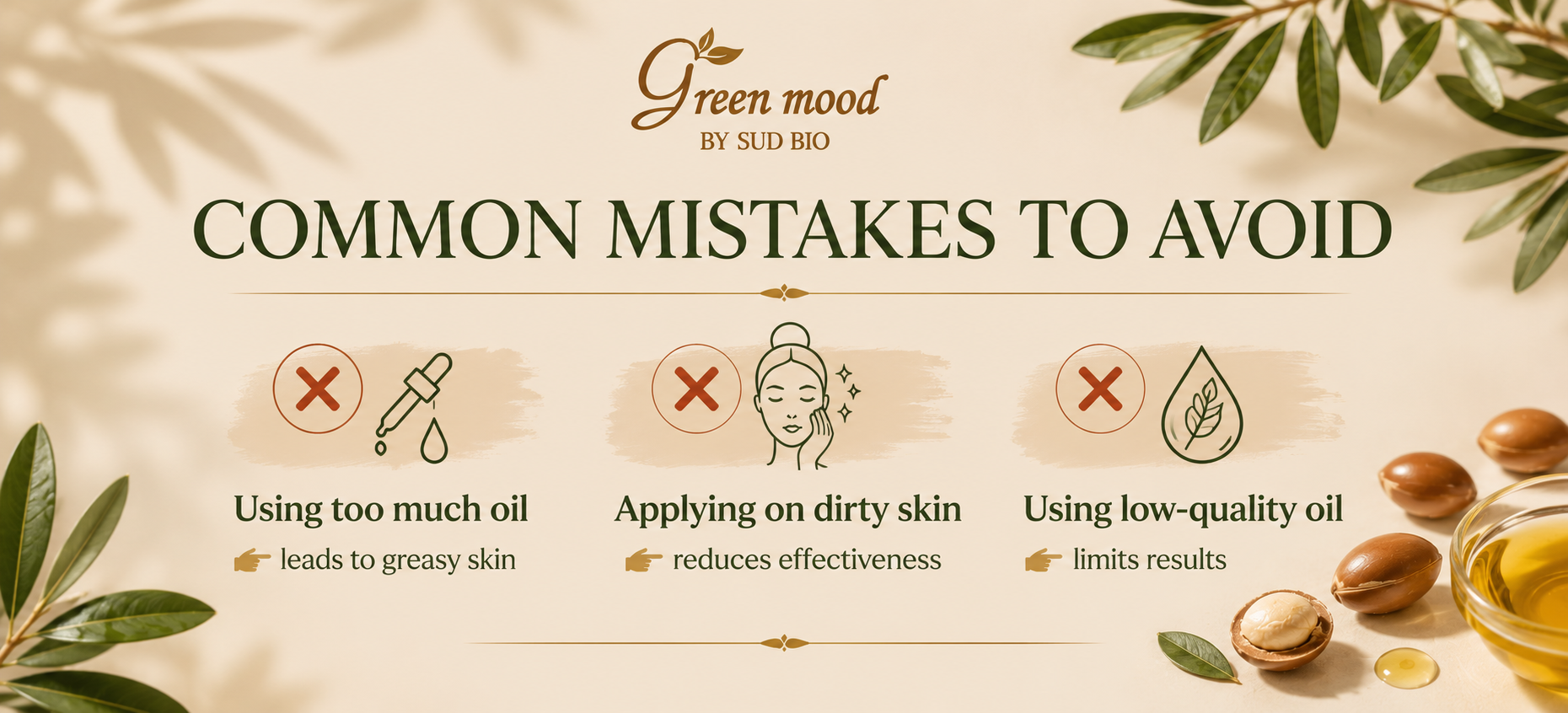
Common Mistakes
Coconut oil as a face moisturiser
The most common mistake in this comparison, and the reason “natural oils broke me out” is a whole genre. Listed at 4, non-absorbing, occlusive: rinse-off only on a face. Argan is the leave-on.
Coconut oil as a daily leave-in
Dull, heavy, dusty, flat by lunchtime, and white flecks in winter. Coconut is a mask you wash out; argan is what you wear.
One shampoo after a coconut mask
The film stays and the hair reads as “coconut oil made my hair greasy and stiff”. Two washes, always.
Coconut oil on a flaky, itchy scalp
If the flaking is yeast-driven — dandruff, folliculitis — lauric acid feeds it. Argan for a merely dry scalp; an antifungal shampoo for a flaky one.
Forcing coconut oil on hair that rejects it
Fine, low-porosity and protein-sensitive hair sits under coconut oil and goes stiff. Stop, and use argan. The hair is telling you something true.
Using argan oil where occlusion is the point
The argan-side mistake. On cracked heels or eczema-prone shins in winter, a light absorbing oil is not enough; coconut’s film is what seals. Use the right tool.
Buying a blended argan oil for the comparison to hold
Everything above assumes a pure, unrefined argan oil. A refined or silicone-cut “argan” product is heavier, absorbs worse and coats — which makes it a poor coconut oil rather than a good argan oil. The INCI should read Argania spinosa kernel oil and nothing else; see how to recognize pure argan oil.
Choosing Well
Argan oil
- Single ingredient — Argania spinosa kernel oil, nothing added.
- Cold-pressed and unrefined — refining removes part of the vitamin E, sterols and polyphenols and changes the texture.
- Certified organic — USDA Organic, ECOCERT or CCPB confirms the sourcing and processing chain.
- Moroccan origin, stated — the tree grows nowhere else at scale.
- Sensory check — a light nutty aroma that fades on the skin; perfumed means fragrance added, odourless usually means refined.
Coconut oil
- Virgin (unrefined) for skin and hair — cold-pressed from fresh flesh, smells of coconut, keeps its minor compounds. Refined is fine for hair if the scent bothers you; the fatty acid profile is nearly the same.
- No fractionated oil for hair masks — “fractionated” or “MCT” coconut oil has had the lauric acid removed, which is the part that does the work in hair. It is the one coconut fraction that is fungal-acne safe, so it has its own use, but not this one.
- Plain — coconut “hair oils” with added fragrance, silicones or essential oils are formulated products with a different dose and a different result.
The Green Mood Standard
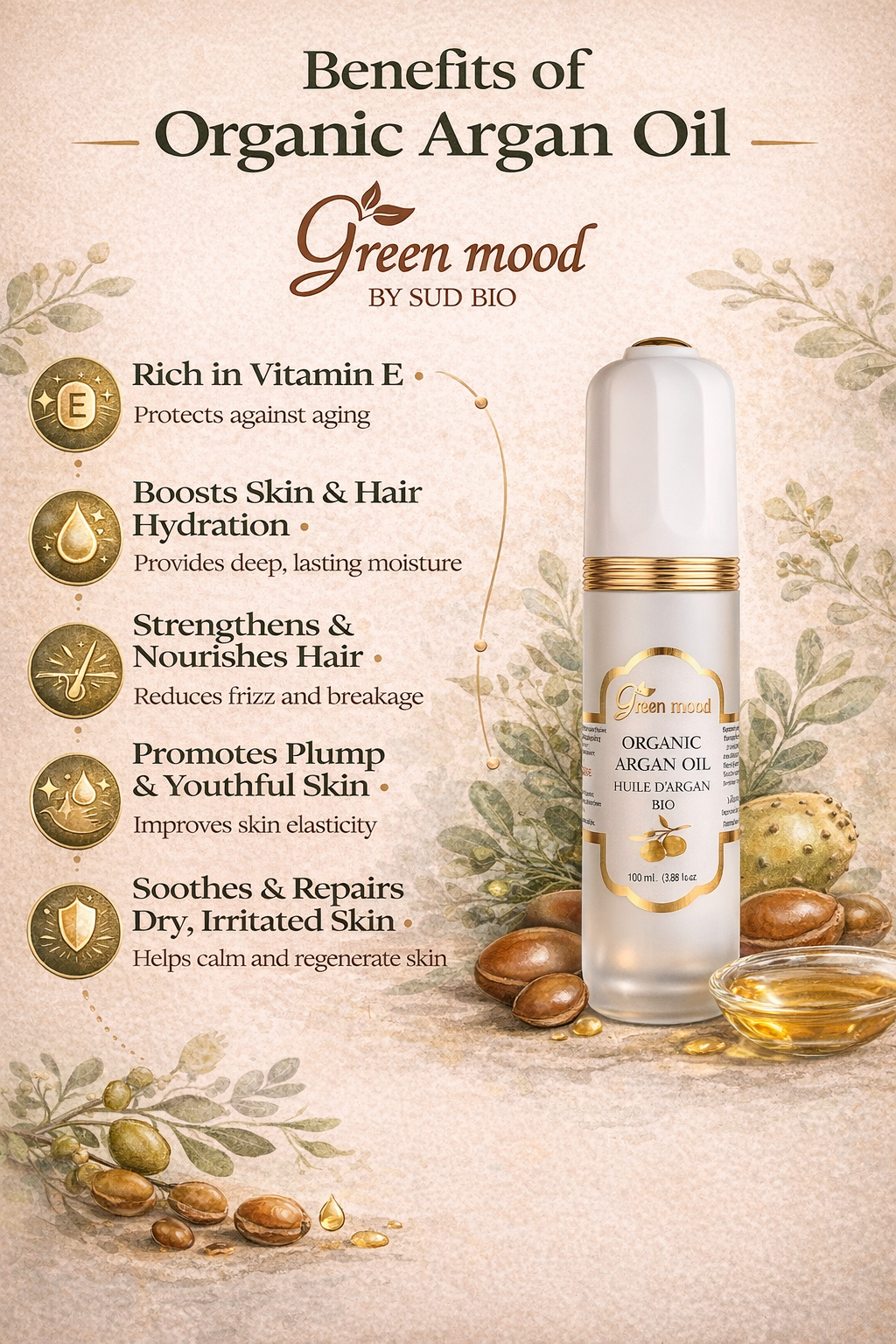
Green Mood’s Pure Argan Oil is the argan side of every comparison in this guide:
- Cold-pressed from certified organic argan kernels
- Single-ingredient — Argania spinosa kernel oil, nothing added
- Unrefined, so the light texture, fatty acid balance and vitamin E content are kept as pressed
- Unscented — the version for face, scalp and sensitive skin
- Certified by USDA Organic, ECOCERT and CCPB
- Produced in Morocco under ISO 22716 cosmetic good manufacturing practice
For the weekly deep-treatment step on lengths without mixing oils at home, the argan oil hair mask is built for it. For the other comparisons people ask about: argan oil vs castor oil and prickly pear oil vs argan oil.
-
Best SellerPure Botanical
Pure Argan Oil
Price range: 194 MAD through 281 MAD
Frequently Asked Questions
Is argan oil or coconut oil better for hair?
Depends on the job. Coconut oil is the better deep treatment: applied to dry hair before shampooing, it is the one oil shown to reduce protein loss from the shaft. Argan oil is the better daily oil: two to four drops on damp lengths give shine and frizz control without weight, and it can be used every wash. Thick, coarse, damaged hair benefits from both in sequence; fine and low-porosity hair does better with argan alone.
Which is better for the face, argan oil or coconut oil?
Argan, for every skin type, at one to three drops on damp skin. Coconut oil is listed at 4 on comedogenic rating lists and does not absorb, so it sits on the face as a film and congests most skins within a week or two. Its only facial use is as a rinse-off makeup remover followed by a normal cleanser.
Can I mix argan oil and coconut oil?
Yes, and for hair masks it is the best way to use coconut oil: two parts argan to one part melted coconut, applied to dry lengths for an hour, shampooed out twice. The argan keeps the mix liquid and rinsable and takes the edge off the stiffness coconut leaves on some hair. For daily hair use, the face, and daily body oil, use argan alone.
Why does coconut oil make my hair stiff or dry?
Because it is sitting on the hair rather than in it. Fine, low-porosity and protein-sensitive hair does not take coconut oil up, so the oil stays on the surface and the hair reads as brittle. It is a well-known pattern, not a fault in your routine. Switch to argan, which stays light and does not have this effect.
Is coconut oil good for acne?
No. Lauric acid has antibacterial activity in the laboratory, which is where the idea comes from, but coconut oil is one of the most congesting oils available and blocks the pores that acne starts in. On acne-prone skin, argan oil at one drop after the treatment is the oil to use; see the argan oil for acne guide.
Which oil is better for dry skin?
For normal-to-dry body skin day to day, argan on damp skin after the shower. For very dry, rough or eczema-prone skin — cracked shins, hands, heels — coconut oil at night: its occlusive film has clinical evidence as a moisturiser for dry skin and childhood eczema. On a dry face, argan; coconut congests it.
Argan oil or coconut oil for curly hair?
Both, in order. Coconut as the weekly pre-shampoo mask on dry curls for the protein-loss benefit coarse, high-porosity textures need; argan on soaking-wet hair after washing, four to six drops scrunched in, to define and seal without crunch. Low-porosity curls usually do better with argan alone.
Can I leave coconut oil in my hair overnight?
On thick, coarse or very damaged hair, yes, then two shampoos in the morning. On fine, low-porosity or long hair, no — it flattens, stiffens and is hard to remove. Argan oil is the overnight option for hair that cannot take coconut.
Is coconut oil or argan oil better for a beard?
Argan, daily, for the beard and the skin beneath it. Coconut oil on beard skin congests it within the week. If a coarse beard needs more control, a drop of castor oil on the ends does that job better than coconut — see argan oil vs castor oil.
Which oil is better for the scalp?
Argan for regular care: five to eight drops massaged in weekly and washed out. Coconut oil is a gamble on a flaky scalp, because the yeast behind dandruff feeds on its lauric acid; some people find it soothes a dry scalp, others find flaking worsens. An itchy, flaky scalp wants an antifungal shampoo, not an oil.
Does coconut oil or argan oil protect from the sun?
Neither. Coconut oil’s laboratory SPF of around 7 does not translate into protection on skin, and nothing below SPF 30 counts. Both oils go under sunscreen in the morning or in the evening only.
Why is argan oil so much more expensive than coconut oil?
Coconut is a bulk tropical crop pressed at scale; argan grows in one region of Morocco, the kernels are extracted largely by hand from a hard shell, and each litre needs the fruit of several trees. Per use the gap narrows: argan is dosed in drops, and one bottle lasts months on face and hair.
The Bottom Line
Argan oil and coconut oil are not competing for the same job. Argan is the oil you wear: face, daily hair, body, beard — light, absorbed, and safe on skin that congests. Coconut is the oil you wash out: the weekly deep treatment for thick or damaged hair, with the only protein-loss evidence any oil has, and the night-time seal for very dry body skin. Put coconut on a face or leave it in fine hair and it fails; ask argan to do a deep repair on bleached, coarse hair and it underdelivers.
If you own one bottle, own the argan: it covers nine of the eleven jobs in the table above, every day. If your hair is thick, coarse or damaged, add a jar of virgin coconut oil for the weekly mask, and thin it with the argan you already have.