
🌍 Free shipping above 150 € worldwide.

-
WhatsApp: +212 6 67 36 28 66
-
Email Address: contact@greenmood.ma
🌍 Free shipping above 150 € worldwide.


Filter
Showing the single result
-
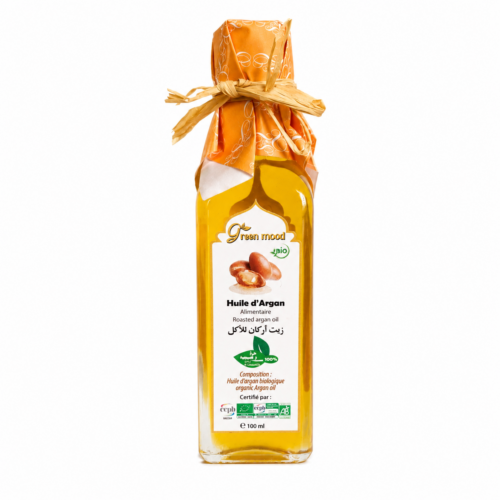
Culinary Argan Oil – 100 ml
194 MAD
CULINARY ARGAN — MOROCCAN KITCHEN TRADITION
Culinary Argan Oil: the Edible Moroccan Oil, Cold-Pressed from Roasted Kernels
Culinary argan is one of Morocco's oldest food traditions — an amber, aromatic oil pressed from roasted argan kernels, drizzled over tagines, whisked into amlou, poured onto couscous at the end of cooking. Distinct from cosmetic argan in every step of its production, made specifically for the plate.
This category holds our Culinary Argan Oil 100 ml — food-grade throughout, produced in Morocco from roasted argan kernels. Not to be confused with our cosmetic argan oils, which come from raw kernels and are meant for skin and hair only.
CULINARY — FOOD GRADE
Culinary Argan Oil 100 ml
Roasted-kernel argan oil for edible use — the Moroccan drizzle
Cold-pressed from roasted argan kernels sourced through certified Souss cooperatives, produced in a food-grade line throughout. Deep amber colour, distinctive nutty aroma with roasted notes, ideal for finishing dishes and preparing amlou. A traditional Moroccan ingredient, still hand-produced in the same regions where cosmetic argan is made — but from a distinct process.
- Food-grade production line
- Distinct from cosmetic argan — not interchangeable
- Ideal for finishing, drizzling, amlou
- Not suitable for high-heat cooking
- 100 ml format — glass bottle
Critical: Culinary and Cosmetic Argan Are Not Interchangeable
These are two distinct products from the same tree. Culinary argan is for the plate only. Its roasted-kernel process gives it a nutty flavour and aromatic profile suited to food — but it doesn't have the neutral, near-odourless profile that skincare requires, and it isn't produced through the raw-kernel process that keeps cosmetic argan's active nutritional profile intact for the skin.
Cosmetic argan is for skin only. It is not produced in a food-grade line and is not intended for consumption. For skincare, see our Pure Argan Oil; for the kitchen, this culinary version is the correct product.
Culinary vs Cosmetic Argan: the Full Comparison
Culinary Argan Oil
- KERNEL PREPARATION
- Kernels are roasted before pressing
- COLOUR
- Deep amber, richer
- AROMA
- Distinctive roasted, nutty, warm
- USE
- Edible only — drizzle, amlou, tagine finish
- PRODUCTION LINE
- Food-grade throughout
- SHELF LIFE
- Around 12 months after opening
- STORAGE
- Cool cupboard, sealed, away from heat
Cosmetic Argan Oil
- KERNEL PREPARATION
- Kernels are pressed raw, without roasting
- COLOUR
- Pale golden yellow
- AROMA
- Subtle, nearly neutral, faintly nutty
- USE
- Skin, hair — face, body, hair care
- PRODUCTION LINE
- Cosmetic-grade — not for consumption
- SHELF LIFE
- 12 to 24 months after opening
- STORAGE
- Bathroom shelf, sealed, away from light
Six Uses of Culinary Argan Oil
Culinary argan is a finishing oil — never heat it. Its flavour and nutritional profile are at their best raw or barely warmed. Here are the traditional and modern applications.
Amlou
The traditional Moroccan spread — roasted almonds, culinary argan, honey. Blend into a thick paste, spread on bread. The most emblematic use.
Tagine Finish
Drizzle a teaspoon over a tagine just before serving. The oil adds a nutty depth without altering the cooked flavours underneath.
Couscous Drizzle
Drizzle onto grains and vegetables at the end of preparation, in place of olive oil. Distinctive Moroccan finish for celebration meals.
Salad Dressing
Whisk with lemon juice and a pinch of salt — the base of an unusual, warm-flavoured vinaigrette for winter greens and roasted vegetables.
Grilled Bread
The Moroccan breakfast classic — grilled bread, a drizzle of culinary argan, a spoon of honey. Simple, complete, distinctive.
Goat Cheese & Roasted Vegetables
A modern pairing — drizzle over warm goat cheese, roasted carrots, roasted squash. The nutty amber note pairs with earthy flavours.
How to Use Culinary Argan Oil
Never heat it
Culinary argan is a finishing oil. Heating breaks down its flavour profile and nutritional value. Use it raw or at most barely warmed by contact with hot food — never in the pan, never in the oven.
Use it sparingly
The flavour is intense — a teaspoon per serving is generous. Excess use masks the flavours it should highlight, and shortens the bottle unnecessarily.
Pair with warm-flavour ingredients
Roasted almonds, honey, dried fruits, roasted vegetables, warm bread, goat cheese, olive oil — culinary argan pairs with the earthy, roasted, sweet register. Less at home with delicate fish or citrus-forward preparations.
The Amlou Recipe
The most emblematic use of culinary argan. Serves four generously.
Ingredients
200 g raw almonds, 100 ml culinary argan oil, 3 tablespoons honey, pinch of salt.
Preparation
1. Roast the almonds at 160°C for 10 minutes until fragrant.
2. Let them cool completely.
3. Blend the almonds until they release their oil and form a paste (5 to 8 minutes in a food processor).
4. Add the culinary argan, honey and salt.
5. Blend until smooth and creamy.
6. Store in a sealed jar at room temperature for up to two weeks.
Serving
Spread on warm bread, use as a dip for fresh fruit, or drizzle onto morning porridge. The traditional Moroccan breakfast.
Why Green Mood?
- Cold-pressed in Morocco — produced in food-grade conditions from roasted kernels sourced through certified Souss cooperatives.
- Traceable production — food-grade line, separate from our cosmetic production, ensuring no cross-contamination between the two use cases.
- Recognised certifications — cosmetic side USDA Organic, ECOCERT, CCPB and ISO 22716. Culinary line food-grade throughout. Details on our certifications page.
- Worldwide tracked shipping — free above 150 €. See our shipping policy.
Frequently Asked Questions
Can I cook with culinary argan oil?
Only as a finishing oil, never for high-heat cooking. Heating breaks down argan's flavour and nutritional profile. Add it at the very end of preparation — drizzled over cooked tagine, mixed into cooled amlou, whisked into salad dressing. Never in a hot pan, never in the oven, never in deep-frying.
What does culinary argan oil taste like?
Warm, nutty, roasted — closer to hazelnut or roasted almond than to olive oil. The roasting of the kernels before pressing develops a distinctive amber flavour that pairs particularly well with honey, roasted almonds, dried fruits and earthy vegetables. Very different from cosmetic argan, which is nearly odourless.
Can I use cosmetic argan oil in the kitchen?
No — cosmetic argan is not food-grade and doesn't have the roasted-kernel flavour that makes culinary argan a kitchen ingredient. It's produced through a different process and in a different production line. Use culinary argan for edible applications, cosmetic argan for skin and hair.
How long does culinary argan oil keep?
Around 12 months after opening, stored in a cool cupboard away from heat and light, with the cap sealed tightly. A rancid smell or clearly changed flavour signals the oil should be replaced. Storing near the stove or on a sunny counter shortens shelf life significantly — culinary oils are more sensitive to heat than cosmetic ones.
What is amlou?
The traditional Moroccan spread — a paste made from roasted almonds, culinary argan oil, honey, and a pinch of salt. Blended until smooth and creamy, spread on bread, used as a dip. It's one of Morocco's most iconic breakfast items and the most authentic use of culinary argan. Our full recipe is above.
Is culinary argan oil healthy?
It's a naturally source of vitamin E and unsaturated fatty acids, which are components of a balanced diet. Like any oil, it should be used in moderation — the concentrated caloric density is high. It doesn't cure or treat medical conditions, but as part of a Mediterranean-style diet it fits well. For any specific dietary or medical question, consult a healthcare professional.
Continue Exploring
Extend the Moroccan botanical experience beyond the kitchen: