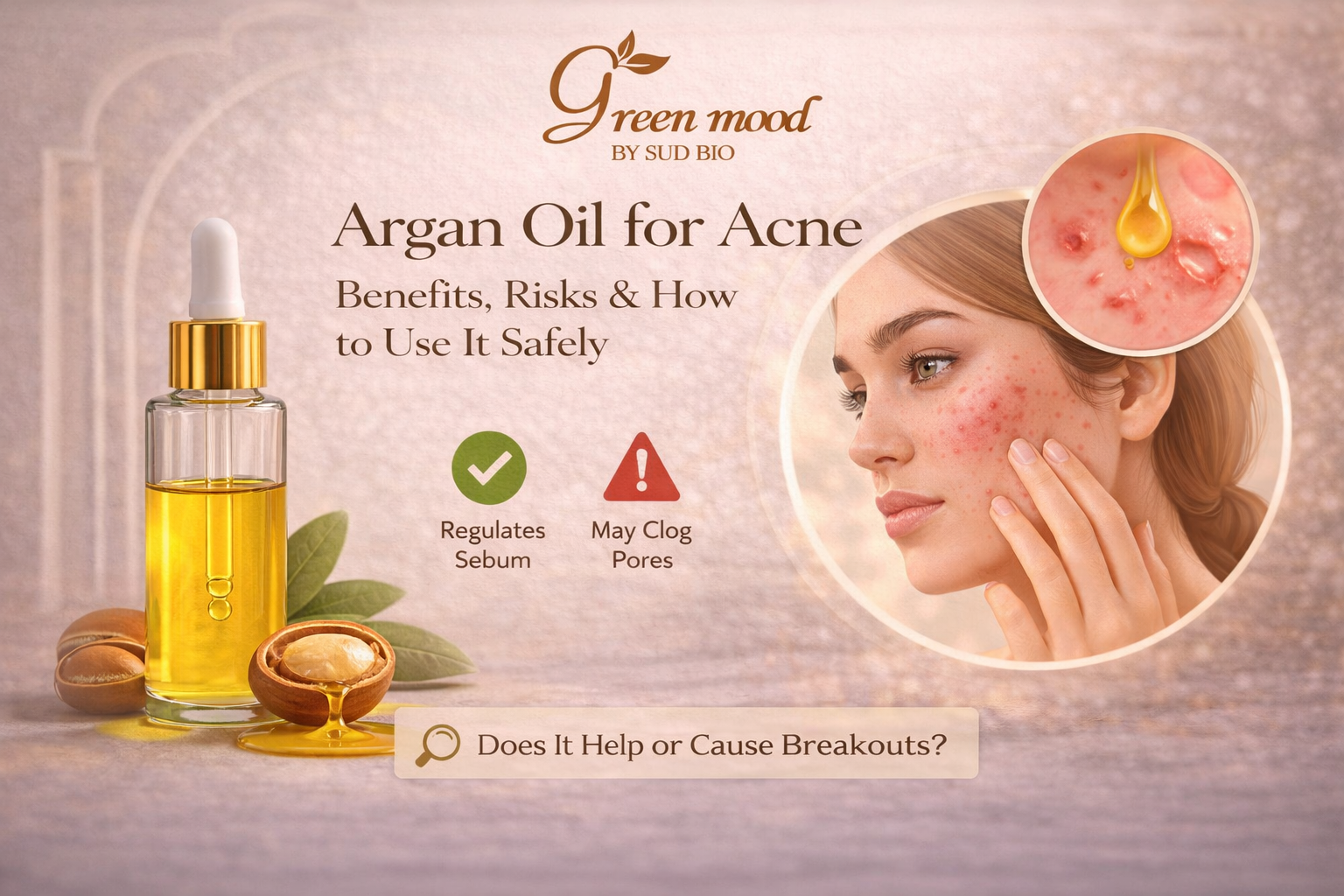
Argan Oil for Acne: Does It Help or Cause Breakouts?
Putting oil on acne-prone skin sounds like the wrong idea, and for most plant oils it is. Argan oil is one of the exceptions: light, fast-absorbing, rich in the linoleic acid that acne-prone sebum tends to lack, and rarely pore-clogging when it is pure and used in small doses. It does not treat acne — no oil does — but it addresses the problem that makes acne routines fail: skin that is stripped, irritated, and producing more oil in response.
This guide covers what argan oil does and does not do on acne-prone skin, when it helps and when it causes breakouts, how to use it alongside salicylic acid, benzoyl peroxide or a retinoid, the right dose for each skin type, and what to expect week by week. Everything below is written for the grade of oil Green Mood produces — cold-pressed, unrefined, single-ingredient. For facial use beyond acne, see the argan oil for face guide; the pore question has its own section below: does argan oil clog pores.
Quick answer
Argan oil suits most acne-prone skin when the oil is pure and the dose is small. One to two drops on damp skin, applied after your acne treatment, hydrate without congestion, calm the redness and flaking that treatments cause, and help stop the rebound oil production of stripped skin. It does not clear acne on its own, it is not fungal-acne safe, and it does not remove scars. Breakouts from argan oil almost always trace back to three things: too much oil, oil applied over sunscreen or makeup, or a diluted or refined product.
Does Argan Oil Help Acne? What It Can and Cannot Do
Acne is a follicle problem: excess sebum, dead cells that fail to shed properly, bacteria (Cutibacterium acnes) and inflammation. Argan oil acts on the environment around that problem — sebum quality, barrier condition, inflammation — not on the bacteria or the blocked follicle itself. Being precise about this is what separates a useful routine from a disappointing one.
Argan oil can
Argan oil cannot
Hydrate acne-prone skin without a heavy or occlusive film
Kill acne bacteria or unblock a clogged follicle
Calm the redness, tightness and flaking that acne treatments cause
Replace salicylic acid, benzoyl peroxide, a retinoid or a prescription
Help stop the rebound oil production of stripped skin
Clear cystic or nodular acne
Support the barrier so marks fade on a normal timeline
Fill pitted scars or erase pigmentation
Fit an oily, combination, dry or sensitive acne-prone routine
Suit fungal acne (Malassezia folliculitis)
Why Argan Oil Suits Acne-Prone Skin
Three properties explain why argan oil behaves differently from most oils on a breakout-prone face.
1. A linoleic-rich fatty acid profile
Argan oil (Argania spinosa kernel oil) is roughly 45% oleic acid and 33% linoleic acid, with the remainder mostly palmitic and stearic. That linoleic share is the point. Research going back to the 1980s has found that the sebum of acne-prone skin tends to be relatively low in linoleic acid, and that this deficit is linked to the abnormal keratinisation that plugs follicles. In one small clinical study, applying linoleic acid topically for a month reduced the size of microcomedones — the invisible early stage of every blackhead and pimple. Argan oil is not a linoleic acid treatment, but it is one of the few everyday oils whose profile leans in the right direction. Oils dominated by oleic acid (olive, most nut oils) or by saturated fats (coconut) lean the wrong way.
2. Light texture, low comedogenic tendency
Argan absorbs within a few minutes and leaves no film — the practical difference between an oil that sits in pores and one that does not. On the comedogenic rating lists circulating online it is listed at 0, the lowest score. Treat those lists as a rough guide: they derive largely from an old rabbit-ear assay that predicts human skin imperfectly, and any oil can congest skin if you apply enough of it. The reliable test is your own skin over two to three weeks at one to two drops.
3. Antioxidants that calm treated skin
Argan oil carries a high load of tocopherols (vitamin E, in the region of 60 to 90 mg per 100 g), plus plant sterols, squalene and polyphenols. Together these limit the oxidative stress that keeps acne inflammation running, and they soothe the sting and peeling that salicylic acid, benzoyl peroxide and retinoids leave behind. Skin that is calm tolerates its treatment better — and a treatment that is tolerated is one that gets used every day.
There is also a sebum angle. Stripped skin over-produces oil, and a small four-week study of a cream containing argan oil reported lower surface sebum readings on oily skin. The mechanism is indirect — when the barrier is comfortable, the skin has less reason to compensate — but it is why argan oil so often leaves oily, acne-prone skin less shiny rather than more. It is also why refining matters: Green Mood’s Pure Argan Oil is left unrefined so that none of this profile is stripped out.
194 MAD–281 MADPrice range: 194 MAD through 281 MAD
Does Argan Oil Clog Pores?
For most people, no. Pure argan oil is one of the least congesting plant oils available, which is why it appears in so many “acne-safe oil” lists and why it can be used on oily and acne-prone faces at all. That said, “non-comedogenic” is a tendency, not a promise, and three conditions turn a safe oil into a congesting one:
Dose. Two drops absorb; six drops sit on the surface, mix with sebum and dead cells, and stay in the pore. Most “argan oil broke me out” reports come from people using it like a body oil.
What is underneath it. Oil layered over sunscreen, makeup, sweat or the residue of an old routine traps all of it against the skin. Argan oil goes on clean, slightly damp skin, or not at all.
What is in the bottle. Many products sold as argan oil are blends with mineral oil, silicone or fragrance, and refined argan oil has lost part of the profile that makes the pure oil light and well tolerated. A blend can clog pores that the pure oil would not.
A small minority of very oily skins develop closed comedones from almost any oil, argan included. If that is you, the answer is a patch of skin along the jawline for ten to fourteen days before committing the whole face.
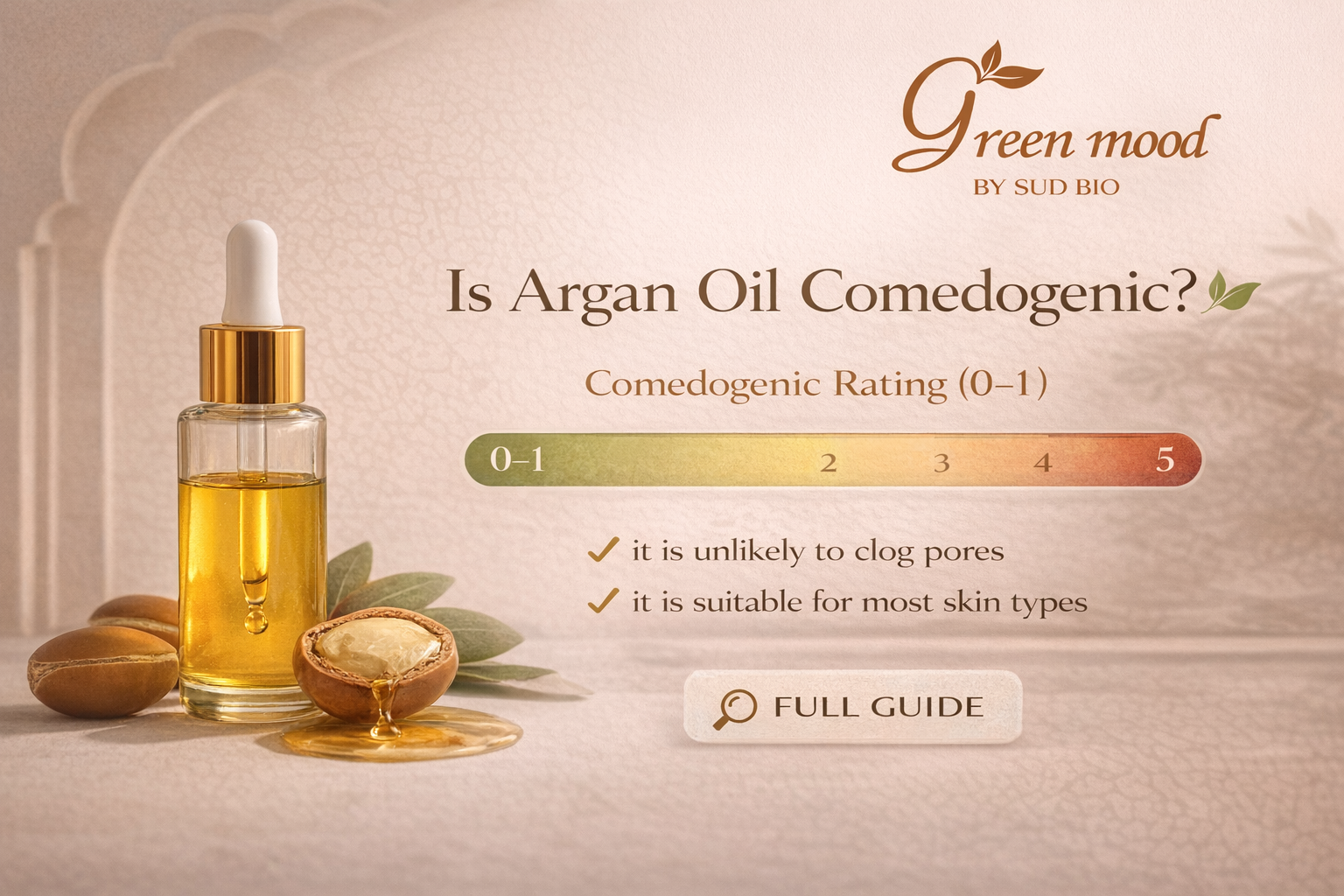
Is argan oil comedogenic?
No, for most skin. “Comedogenic” describes an ingredient’s tendency to form comedones — blackheads and whiteheads — inside the follicle. Argan oil is listed at 0 on the rating lists in circulation, and its light texture and linoleic-leaning profile are the reason. The rating is not a promise: dose, what sits underneath the oil, and purity can override it, which is why the three conditions above matter more than the number.
When Argan Oil Causes Breakouts — and Why It Is Not Purging
“Purging” is a specific thing: a temporary flare that happens when an ingredient speeds up cell turnover and pushes microcomedones to the surface faster. Retinoids, AHAs, BHAs and benzoyl peroxide can do that. Argan oil does not accelerate turnover, so it does not purge. A breakout that starts after adding argan oil is a genuine reaction, and it tells you something is off. Four causes cover nearly every case:
Too much oil. Three or more drops on an oily face leaves a film that congests. Fix: one to two drops, pressed onto damp skin.
Oil over an unclean surface. Applied on top of sunscreen, makeup or sweat, the oil seals everything in. Fix: cleanse first, apply on damp skin, and put SPF on top rather than underneath.
A diluted or refined oil. A blend behaves like a different product, and a refined oil behaves like a weaker one. Fix: a single-ingredient INCI (Argania spinosa kernel oil, nothing else), cold-pressed, unrefined. See how to recognize pure argan oil.
The wrong kind of acne. Fungal acne — small, uniform, often itchy bumps across the forehead, chest or back — is a yeast (Malassezia) overgrowth, not bacterial acne, and the yeast feeds on the fatty acids in plant oils. Argan oil, like almost every plant oil, makes it worse. See the fungal acne section below.
The rule: if new spots appear within the first two weeks, stop for a week. If they clear, the oil or the dose was the problem. Reintroduce at one drop, evenings only — or, for a skin that reacts to every oil, not at all.
Benefits of Argan Oil for Acne-Prone Skin
Kept within the limits above, argan oil earns its place in an acne routine for six reasons. Some show up on the first evening; the structural ones build over three to four weeks.
1. Hydration without congestion
Acne-prone skin still needs lipids — often more than average, because treatments strip them. Argan oil supplies them in a form the skin recognises, absorbs quickly, and does not leave a film that mixes with sebum. Cheeks and jawline feel comfortable without the T-zone turning shiny.
2. Less redness and flaking from treatments
Salicylic acid, benzoyl peroxide and retinoids work by design and irritate by side effect. One to two drops of argan oil applied afterwards takes the edge off the sting, the tightness and the peeling that make people abandon a treatment in week two. This is the single most useful thing argan oil does for acne, and it is the reason dermatology routines so often pair an active with a bland, lipid-rich layer.
3. Less rebound oiliness
When cleansers and actives strip the surface, sebaceous glands compensate. A thin lipid layer removes the trigger. Most people with oily, acne-prone skin report a less shiny T-zone by the second week — the opposite of what they expected from an oil.
4. A calmer barrier, fewer irritation-driven breakouts
Not every pimple is bacterial. Rubbing, over-exfoliating and over-drying all cause small inflamed bumps. A barrier that is intact reacts less to heat, sweat, friction and the next new product, and over a month of consistent use those irritation-driven spots grow quieter — even though the oil never touched the deeper acne mechanism.
5. Support while marks fade
The dark or red marks left after a pimple (post-inflammatory hyperpigmentation and erythema) fade on their own over months, provided the skin is not re-irritated and is protected from the sun. Argan oil does not remove pigment, but it keeps the barrier comfortable through that timeline and its vitamin E limits the oxidative stress that darkens marks. With daily SPF, marks fade on the timeline they should, rather than lingering.
6. Comfort on sensitive, acne-prone skin
Skin that is both reactive and breakout-prone tolerates very little. A single-ingredient oil with no fragrance, no essential oils and no preservative is often the only hydrating step such skin accepts. Argan oil is one of the gentlest options in that category.
Argan Oil by Type of Acne
“Acne” covers several different conditions. Argan oil helps some, is neutral on others, and is the wrong choice for one.
Blackheads and whiteheads (comedonal acne)
This is where the linoleic acid angle matters most: comedonal acne is a plugging problem, and a lipid layer that leans linoleic helps keep sebum less sticky. Argan oil will not dissolve existing blackheads — that is a job for salicylic acid or a retinoid — but it supports a surface that forms fewer new ones. Use one to two drops after the exfoliating step, not instead of it.
Pimples (papules and pustules)
Inflamed spots need an antibacterial or anti-inflammatory treatment: benzoyl peroxide, azelaic acid, a prescription topical. Argan oil goes on after that layer to calm the surrounding skin and limit the peeling. Do not apply it onto an open, weeping spot.
Cystic and nodular acne
Deep, painful lesions sit well below anything a topical oil reaches. Cystic acne is a dermatologist-first condition. Argan oil has one role here: as the barrier-support layer that makes a prescription regimen (often a retinoid or oral treatment) bearable on the skin. It is not a treatment for the cysts themselves.
Fungal acne (Malassezia folliculitis)
Uniform small bumps, often itchy, often on the forehead, hairline, chest or back, that do not respond to normal acne treatment. This is a yeast overgrowth, and Malassezia metabolises fatty acids with carbon chains between roughly 11 and 24 — which includes the oleic and linoleic acids that make up most of argan oil. Argan oil is not fungal-acne safe. Neither is jojoba, rosehip or coconut. If your “acne” fits this description, skip plant oils entirely and use squalane or a plain hydrating serum instead.
Acne scars and dark marks
Two different things get called scars. Flat dark or red marks (post-inflammatory hyperpigmentation or erythema) are temporary and fade over three to twelve months; argan oil supports that process as described above, alongside daily SPF. Pitted scars (ice-pick, boxcar, rolling) are structural, and no oil fills them — that takes microneedling, laser or fillers. Argan oil is worth using on scarred skin for comfort and barrier support, not as a scar treatment.
Adult and hormonal acne
Adult acne along the jaw and chin usually comes with the first fine lines and skin that is oily in places and dry in others. Argan oil is well suited to this combination: it hydrates the dry areas, does not aggravate the oily ones, and its antioxidant profile addresses early ageing at the same time. Pair it with whatever treats the hormonal driver — that part is not a job for an oil.
How to Use Argan Oil for Acne: 5 Methods
One bottle covers every method below. What changes is the dose, the step in the routine, and how often. For the general technique, see how to use argan oil; what follows is the acne-specific version.
Method 1 — As the last hydrating step after your treatment (daily)
Cleanse with a gentle, non-stripping cleanser. Pat dry, leaving the skin slightly damp.
Apply your acne treatment (salicylic acid, benzoyl peroxide, azelaic acid, or a retinoid at night) and let it absorb for five to ten minutes.
Warm one to two drops of argan oil between the fingertips.
Press onto the face — cheeks and jawline first, T-zone last and lightly. Do not rub.
Morning: apply SPF on top after a minute. Evening: nothing on top.
Best for: everyone on an active treatment. This is the default method.
Method 2 — Buffering under a retinoid (irritation control)
Cleanse and pat dry.
Press one drop of argan oil across the face and wait two to three minutes.
Apply the retinoid (adapalene, tretinoin) on top as usual.
Best for: the first four to six weeks of a retinoid, or any time peeling and redness make you want to stop. Buffering slows penetration slightly and makes the retinoid far easier to tolerate. Once the skin has adapted, switch back to Method 1.
Method 3 — Spot application on healing pimples
After the spot treatment has dried, put a single drop on a clean fingertip.
Dab onto the dry, flaking skin around a healing pimple — not onto an open or weeping lesion.
Leave overnight.
Best for: the crusty, over-dried stage that benzoyl peroxide leaves behind. It stops the skin cracking and reduces the chance of a dark mark.
Method 4 — Mixed into a light moisturiser (very oily skin)
Take your usual pea-sized amount of a light, water-based moisturiser.
Add one drop of argan oil and blend in the palm.
Apply as normal.
Best for: very oily skin that wants the barrier benefit without ever feeling an oil on the face. The dilution keeps the finish matte.
Method 5 — Oil-first cleanse on blackhead-prone zones (weekly, rinse off)
On dry skin, massage three to four drops into the nose, chin and forehead for one to two minutes.
Add warm water and keep massaging as the oil emulsifies.
Rinse, then follow with your normal cleanser so no oil is left behind.
Best for: congested, blackhead-prone T-zones once or twice a week. The oil softens the sebum plug so the second cleanse lifts more of it. The second cleanse is not optional.
How Much Argan Oil to Use on Acne-Prone Skin
Dosage is where almost every argan oil failure on acne-prone skin happens. The right amount is smaller than it looks.
Acne-prone skin type
Daily (after treatment)
Frequency
Note
Oily
1 drop
Evenings, then twice daily if tolerated
Cheeks and jaw; skip the nose if already shiny
Combination
1–2 drops
Twice daily
Two drops on dry zones, none on the T-zone
Dry or dehydrated (on treatment)
2–3 drops
Twice daily
Layer a hydrating serum underneath
Sensitive and reactive
1 drop
Evenings for two weeks, then twice daily
Patch-test on the jawline first
Adult acne with first fine lines
2 drops
Twice daily
Extra half-drop around the eyes
Start at the low end and hold it for a week. If the skin still feels tight the next morning, add a drop. If it looks shiny an hour after application, remove one. Two drops is the ceiling for most acne-prone faces — assuming a pure, unrefined oil. A diluted or refined argan oil tends to behave as if it were half the strength and twice as heavy.
Using Argan Oil with Acne Treatments
Argan oil is compatible with every common acne active. The only variables are order and timing.
Treatment
Order
How to combine
Salicylic acid (BHA)
Acid first, oil after
Wait 5–10 minutes. Salicylic acid is oil-soluble, so it does its work in the pore before the oil arrives.
Benzoyl peroxide
BP first, oil after
Let BP dry fully. The oil then counters the peeling BP is known for. Do not mix them in the palm.
Adapalene / tretinoin
Retinoid first (or oil first to buffer)
Evenings only. Buffer with oil underneath for the first weeks if irritation is high, then move the oil on top.
Azelaic acid
Azelaic first, oil after
Pairs well; the oil reduces the itch and dryness azelaic acid can cause.
Niacinamide or hyaluronic serum
Serum first, oil after
Water-based products go under oil, always.
Topical antibiotic (e.g. clindamycin)
Antibiotic first, oil after
Apply as prescribed; the oil goes on once it has dried.
Oral isotretinoin
Oil as the moisturising layer
Isotretinoin dries skin severely; argan oil is a good bland lipid layer. Confirm with your dermatologist.
Sunscreen
Oil first, SPF last
Oil over sunscreen dilutes the film. Do not reverse this.
Two things argan oil should not be combined with on acne-prone skin: heavier oils layered on top (the point is to keep the layer thin), and undiluted essential oils such as tea tree mixed into it — an antimicrobial essential oil belongs in a properly diluted spot treatment, not in your daily hydrating step.
194 MAD–281 MADPrice range: 194 MAD through 281 MAD
Argan Oil for Acne Before and After: What to Expect
Set the right expectations, because argan oil is judged unfairly in both directions — blamed for breakouts it did not cause and expected to clear acne it was never going to touch. On its own timeline, this is what consistent use delivers on acne-prone skin.
Days 1 to 7
Immediate relief from the tightness and sting of treatments
Less visible flaking around the nose and mouth
No new congestion if the dose is right — this week is the test
Weeks 2 to 4
Less redness around existing spots
A less shiny T-zone as rebound oil production settles
Better tolerance of your active treatment, so you skip fewer nights
Weeks 4 to 8
Fewer small irritation-driven pimples
Marks from earlier breakouts visibly lighter (with daily SPF)
Skin that reacts less to heat, sweat and new products
Months 2 to 3
A steadier skin overall: fewer flare-ups linked to dryness or irritation
Texture more even where marks have faded
The acne treatment doing its job on skin that can tolerate it
What will not happen: the deeper acne clearing because of the oil. If after eight weeks the inflamed acne itself is unchanged, the treatment layer needs attention — the oil was only ever the support layer.
Argan Oil vs Other Oils for Acne
Not all “natural oils” are alike on acne-prone skin. The fatty acid balance and the texture decide whether an oil helps or congests.
Oil
Profile
On acne-prone skin
Argan
~45% oleic, ~33% linoleic; light; high vitamin E
Well suited at 1–2 drops. Not fungal-acne safe.
Jojoba
A liquid wax ester, close to sebum; very light
Well suited; slightly less nourishing than argan. Not fungal-acne safe.
Rosehip
~45% linoleic, ~30% linolenic; oxidises quickly
Good for marks; short shelf life; can feel drying on some skins.
Squalane
Saturated hydrocarbon; inert; no fatty acids
The safest option for fungal acne; less antioxidant benefit.
Coconut
~90% saturated, mostly lauric acid; heavy
High congestion risk on the face. Keep it for body and hair.
The two comparisons people ask about most are covered separately: argan oil vs coconut oil, and prickly pear oil vs argan oil — prickly pear seed oil being the lighter, higher-linoleic option worth considering when early ageing is the second concern.
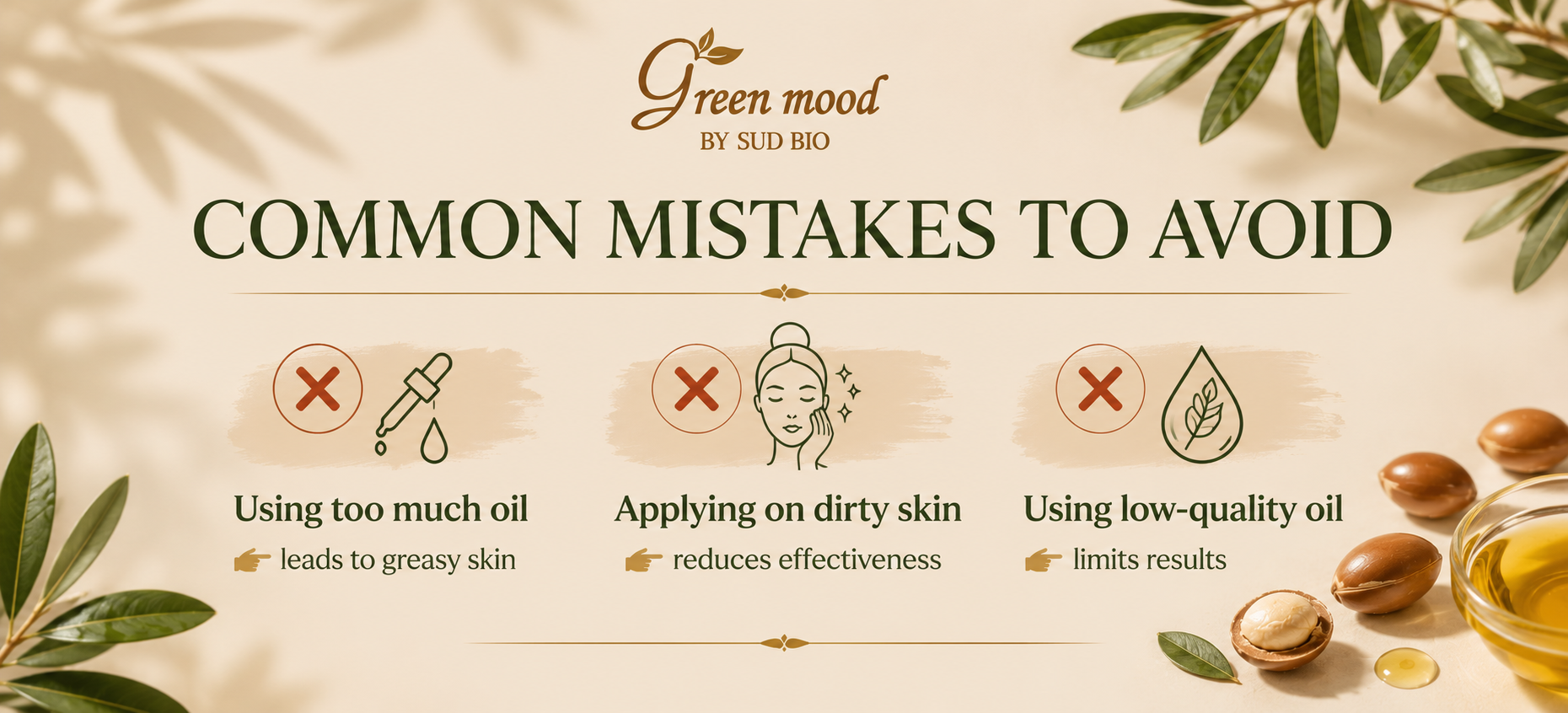
Common Mistakes to Avoid
Using it like a body oil
Three, four, five drops on an oily face. This causes most of the “argan oil gave me acne” stories. One to two drops, pressed on damp skin, is the whole dose.
Putting it on top of sunscreen
Oil over SPF dilutes the protective film and traps the day’s residue. Oil goes under sunscreen in the morning, or in the evening only.
Applying it to open lesions
A picked or weeping spot needs to dry and close, not to be sealed. Apply around a healing pimple, not on it, and only once the surface has closed.
Treating it as the treatment
Argan oil is the support layer. Skipping the salicylic acid, benzoyl peroxide or retinoid because the skin “feels better” hands the acne back its mechanism within a few weeks.
Buying a blend
“Argan oil” on a label means little if the INCI lists five things. Scented or blended argan oils are body and hair products; on an acne-prone face, use only a single-ingredient, unscented argan oil. Fragrance, in particular, has no place on inflamed skin.
Ignoring fungal acne
If the bumps are small, uniform, itchy and unresponsive to acne treatments, the oil is not helping and may be the cause. Stop, and check with a dermatologist or pharmacist.
Who Should Use Argan Oil for Acne — and Who Should Wait
Well suited: mild to moderate acne on oily, combination, dry or sensitive skin; anyone whose treatment is causing dryness, peeling or redness; adult and hormonal acne with early fine lines; skin recovering from a course of treatment, with marks to fade.
Use with care: very reactive skin (patch-test first, one drop, evenings); skin that has broken out from every oil before (test on the jawline before the whole face); active, widespread inflammatory acne not yet under treatment — start the treatment first, add the oil in week two.
Not the right choice: fungal acne; any open or infected lesions until they close; anyone hoping the oil alone will clear cystic or nodular acne. Severe or scarring acne is a dermatologist’s job first, and argan oil is what makes the prescription easier to live with — not what replaces it.
When Argan Oil Is Not Enough
For skin where breakouts are frequent, inflamed and not controlled by a single active, the oil is one step in a routine that also needs a cleanser that does not strip, an exfoliating step, a treatment layer and daily sun protection. For that situation, Green Mood’s anti-acne treatment packs offer a complete ritual in three- and six-month formats, meant to be used alongside — not instead of — any prescription your dermatologist has given you.
Purity matters more on acne-prone skin than for any other use. Inflamed, reactive skin shows the shortcomings of a diluted or refined oil within days, and it is the blends that generate most of the breakout complaints attached to argan oil’s name.
Single ingredient. The INCI list reads Argania spinosa kernel oil and nothing else. No fragrance, no carrier oil, no preservative, no essential oils.
Cold-pressed and unrefined. Refining removes part of the vitamin E, sterols and polyphenols that make the oil calming. Both terms should be stated on the label.
Certified organic. A recognised certification (USDA Organic, ECOCERT, CCPB) confirms the sourcing and processing chain.
Moroccan origin, stated. The argan tree grows almost exclusively in southwestern Morocco; origin should be verifiable.
Sensory check. Pure argan oil has a light, nutty aroma that fades within minutes on the skin. A perfumed smell means added fragrance; no smell at all usually means refined. The texture is light and absorbs fast — if it sits on the surface like a body oil, it is not the grade you want on a breakout-prone face.
Unscented is not a preference here, it is a requirement. Scented argan oils are pleasant on the body and hair; on acne-prone facial skin, fragrance is an irritant with no upside.
194 MAD–281 MADPrice range: 194 MAD through 281 MAD
Frequently Asked Questions
Is argan oil good for acne-prone skin?
Yes, for most people. Argan oil is light, absorbs quickly, is rich in linoleic acid and rarely congests pores when used at one to two drops on clean, damp skin. It supports the barrier and calms the irritation that acne treatments cause. It does not treat the acne itself, so it works best as the hydrating step after a treatment, not as a replacement for one.
Does argan oil clog pores?
Rarely, when the oil is pure and the dose is small. Argan oil is listed at 0 on the common comedogenic rating lists, which are a rough guide. Congestion from argan oil almost always comes from using too much, applying it over sunscreen or makeup, or using a blend rather than a single-ingredient oil. A small minority of very oily skins react to any oil; a two-week patch on the jawline settles the question.
Is argan oil comedogenic or non-comedogenic?
Non-comedogenic for most skin. It is listed at 0 on the comedogenic rating lists, absorbs without leaving a film, and its fatty acid profile leans towards linoleic acid rather than the saturated fats that congest. The rating comes from an old rabbit-ear assay, so read it as a tendency: at one to two drops on clean, damp skin, argan oil rarely forms comedones; at five drops over sunscreen, it can.
Can argan oil cause acne or breakouts?
It can, in specific cases: too high a dose, oil applied to an unclean surface, a diluted or refined product, or fungal acne rather than bacterial acne. Argan oil does not “purge” — it does not speed up cell turnover — so new spots after adding it are a real reaction. Stop for a week; if the spots clear, reduce the dose to one drop or drop the oil.
How do I use argan oil for acne?
Cleanse, apply your acne treatment and let it absorb for five to ten minutes, then press one to two drops of argan oil onto damp skin — cheeks and jaw first, T-zone last and lightly. In the morning, sunscreen goes on top. At night, nothing on top. Start at one drop and hold that dose for a week before adjusting.
How long does argan oil take to work on acne-prone skin?
Comfort and less flaking within the first week. Less redness and a less shiny T-zone by weeks two to four. Fewer irritation-driven spots and lighter marks by weeks four to eight, with daily SPF. The inflamed acne itself is the treatment’s job, not the oil’s — judge that on the treatment’s timeline.
Does argan oil help with acne scars?
It helps flat dark or red marks fade on their natural timeline by keeping the barrier calm and limiting oxidative stress, alongside daily sunscreen. It does not remove pigment and it does not fill pitted scars; ice-pick, boxcar and rolling scars need professional procedures. Use argan oil on scarred skin for comfort and support, not as a scar treatment.
Is argan oil good for cystic acne?
Not as a treatment. Cystic and nodular acne sits deep in the skin and needs a dermatologist, usually a prescription retinoid or an oral treatment. Argan oil’s role in that regimen is as the bland, lipid-rich layer that makes the prescription tolerable on the skin.
Does argan oil help with blackheads?
Indirectly. Its linoleic-leaning profile supports a surface that forms fewer new comedones, and an oil-first cleanse once or twice a week softens plugs in the T-zone so the second cleanse lifts more. It does not dissolve existing blackheads — salicylic acid or a retinoid does that. Use the oil after the exfoliating step, not instead of it.
Is argan oil fungal acne safe?
No. Malassezia, the yeast behind fungal acne, feeds on fatty acids with carbon chains between roughly 11 and 24, which includes the oleic and linoleic acids that make up most of argan oil. If your bumps are small, uniform, itchy and unresponsive to acne treatment, skip plant oils entirely and use squalane or a plain hydrating serum instead.
Can I use argan oil with benzoyl peroxide, salicylic acid or retinol?
Yes, all three. Apply the active first, let it dry or absorb for five to ten minutes, then press the oil on top. With a retinoid, you can reverse the order for the first few weeks — oil first, retinoid on top — to buffer the irritation, then move the oil on top once the skin has adapted.
Is argan oil good for oily skin with acne?
Yes, at one drop. A thin lipid layer removes the trigger that makes stripped skin over-produce oil, and most people with oily, acne-prone skin see a less shiny T-zone by the second week. Apply to the cheeks and jaw and go very lightly, or not at all, on the nose and forehead. Mixing the single drop into a light moisturiser keeps the finish matte.
Does argan oil darken skin or acne marks?
No. Argan oil has no pigmenting effect. Marks darken when they are exposed to the sun without protection, which is why SPF is the non-negotiable partner of any oil on skin that is fading marks. The does argan oil darken skin guide covers the origin of this myth.
Can argan oil replace my acne treatment?
No. Argan oil does not act on the bacteria or the blocked follicle. It replaces the moisturiser in an acne routine, not the treatment. The best results come from pairing the two: the treatment addresses the acne, the oil keeps the skin able to tolerate the treatment.
Can I use argan oil on back or chest acne?
Yes, with the same rules as the face and one extra caution: body acne is more often fungal than facial acne is. If the bumps are uniform and itchy, treat that possibility first. For bacterial body acne, apply the oil after a benzoyl peroxide or salicylic acid wash, in a very thin layer, and let it absorb before dressing.
Should I stop using argan oil if my acne gets worse?
Yes — stop for a week and observe. If the skin improves, the oil, the dose or the product was the problem: reintroduce at one drop in the evenings, switch to a verified pure oil, or leave it out. If the skin does not improve, the flare has another cause and the treatment layer needs reviewing.
The Bottom Line
Argan oil is one of the few plant oils that belongs on acne-prone skin. It hydrates without congestion, calms the irritation that acne treatments cause, settles rebound oiliness, and keeps the barrier steady while marks fade. It does not treat acne, it is not for fungal acne, and it does not remove scars — and knowing those limits is what makes it useful.
Three variables decide the outcome: purity — a cold-pressed, unrefined, single-ingredient oil; dose — one to two drops on damp skin, never a palmful; and order — after the treatment, under the sunscreen. Get those right, and argan oil becomes the step that lets the rest of the routine work.



 Best SellerPure Botanical
 Complete Treatment
 Best SellerComplete Treatment