The Moroccan Hammam Routine: Morocco’s Traditional Body Care Ritual, Step by Step
Five steps in a fixed order, four products, forty-five minutes: the ritual as it is practised in Morocco, explained by the brand that makes the black soap, the kessa glove and the oils it uses.
In Morocco the hammam is not a treatment you book. It is the weekly skincare routine for the body, with a fixed order of steps and a set of gestures most people learn as children. No steam cabin is needed: the whole routine happens in an ordinary bathroom with a hot shower.
This guide describes the ritual as it is practised in a neighbourhood hammam, then shows how to do it at home: the five steps in the right order, how long each one takes, the black soap and kessa technique, the mistakes that ruin a session, how often to do it for your skin type, and what the hammam really does, and does not do, for the skin. It is not a list of spas.
Key takeaways
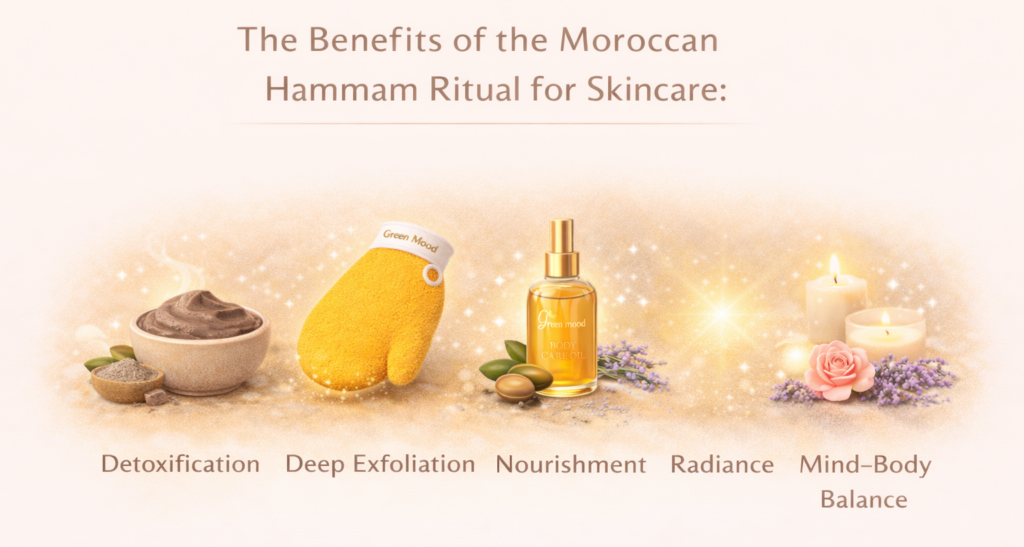
The routine has a fixed order: humid heat, black soap, kessa glove, rhassoul or nila mask, oil. Swap two steps and the exfoliation stops working.
Black soap is not rubbed in. It rests on damp skin for 5 to 10 minutes, then is rinsed off completely before the glove.
The kessa glove is used on damp, soap-free skin, in long strokes, never on the face.
Once a week suits most skin; every two weeks for dry or reactive skin.
Allow 45 to 60 minutes at home. Skin is noticeably smoother to the touch as soon as the session ends; the evenness of tone builds with regular sessions.
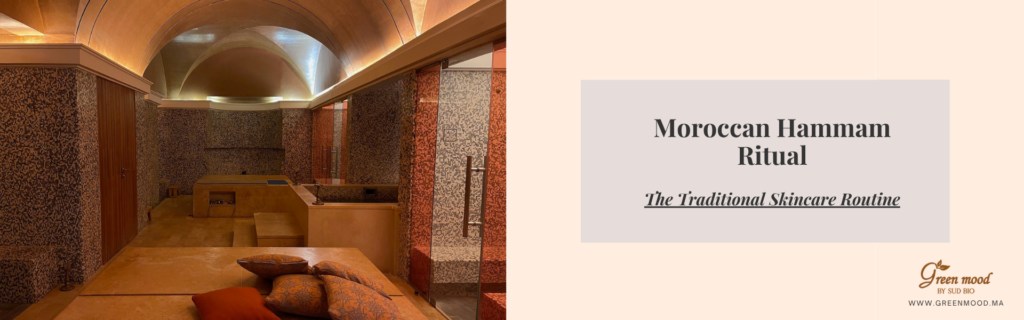
A Moroccan hammam (hammam beldi) is a humid steam bath. The air is around 40 to 50 °C (104 to 122 °F), close to saturation. It is this humid heat, not dry heat, that softens the outer layer of the skin and makes the exfoliation that follows possible. A neighbourhood hammam usually has three rooms of increasing temperature. You settle in the hottest one with your buckets of water, let the steam work on your skin for a good quarter of an hour, then go through the sequence: black soap, kessa glove, rinse, mask, and finally a move back to the warm room to rinse with cooler water.
In most Moroccan hammams the scrub is done by a kessala (a woman) or a kessal (a man), and the gesture is recognisable anywhere: long, firm passes along the length of the limbs that lift grey rolls of dead skin off the body. That gesture, more than any product, is what separates a hammam from a hot shower.
Outside Morocco the same ritual goes by other names. In the Gulf and in much of the English-speaking world it is booked as a “Moroccan bath”; in spa menus it becomes a “hammam experience”. The steps are the ones described below, whatever the name on the door.
Moroccan hammam, Turkish hammam, sauna: what changes
Criterion
Moroccan hammam
Turkish hammam
Sauna
Heat
Humid, 40 to 50 °C
Humid, 40 to 50 °C
Dry, 80 to 100 °C
Cleansing
Olive black soap, rested then rinsed
Thick soap foam
None; you sweat
Exfoliation
Kessa glove, long firm strokes
Kese mitt, over soap foam
None
Afterwards
Rhassoul or nila mask, then oil
Foam massage
Cold shower
What the hammam does for your skin, and what it does not
Much of what is written about hammam benefits describes a feeling rather than an observation. Here is what the routine actually does to the skin, with the mechanism behind each effect, followed by what it does not do.
What the routine does
Removes dead cells from the surface. Humid heat softens the stratum corneum, black soap loosens it, the kessa lifts it off mechanically. This is the most visible effect: skin that is smoother to the touch as soon as the session ends.
Clears the surface of the skin. Black soap dissolves oxidised sebum and product residue; rhassoul absorbs excess sebum. Useful for combination to oily skin, and for the back.
Evens texture and tone. A surface cleared of dead cells reflects light more evenly. The effect holds when sessions are regular.
Improves how oils spread and absorb. A few drops of oil on clean, warm, slightly damp skin spread further and leave less residue than on dry skin.
Relaxes. Heat, slower breathing, the massage of the glove: the pleasant tiredness after a hammam is real, even if it cannot be measured.
What it does not do
It does not “open” your pores. Pores have no muscle to open or close them. Heat softens the sebum sitting inside them, which makes cleansing easier; that is a different thing.
It does not cleanse your body of toxins. Sweating removes water and salts. The effects of a hammam are on the skin and on how you feel.
It does not replace treatment. Inflamed acne, eczema, rosacea: heat and the glove can make a flare worse. Adapt the routine, or wait until the skin is calm.
Precautions
Skip the hammam if you have a fever, on an empty stomach, or right after a heavy meal. If you are pregnant, or have a cardiovascular condition or unstable blood pressure, ask your doctor before a session. Drink water before and after.
The Moroccan hammam routine, step by step
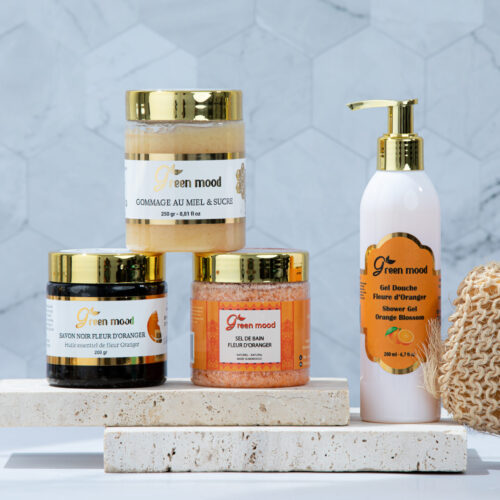
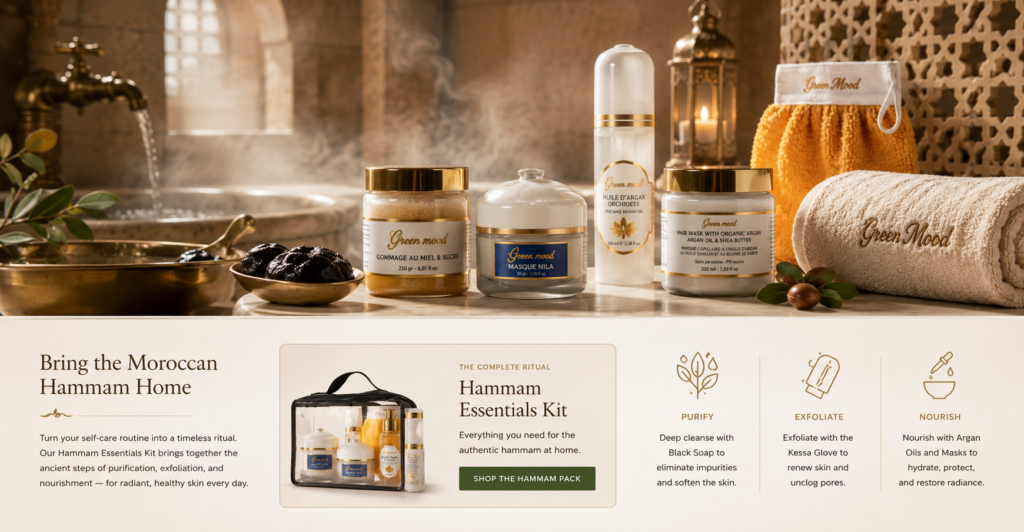
The order matters more than the products. Each step prepares the next: heat for the soap, soap for the glove, glove for the mask, mask for the oil. Allow 45 to 60 minutes with the bathroom door closed, and set everything out before you turn on the hot water: the four products of the ritual (the Green Mood hammam essentials kit brings them together), a small bowl for the mask, a towel, and a glass of water.
1. Humid heat (10 to 15 minutes)
Run the shower very hot with the door closed until the room fills with steam, then stand under water that is hot but comfortable. The aim is to let the outer layer of the skin soften: it becomes slightly plump and tender to the touch. Without this step the black soap does less and the kessa scratches instead of exfoliating.
A hammam habit worth copying: wet the kessa glove now and leave it soaking in hot water, so it is supple when you need it.
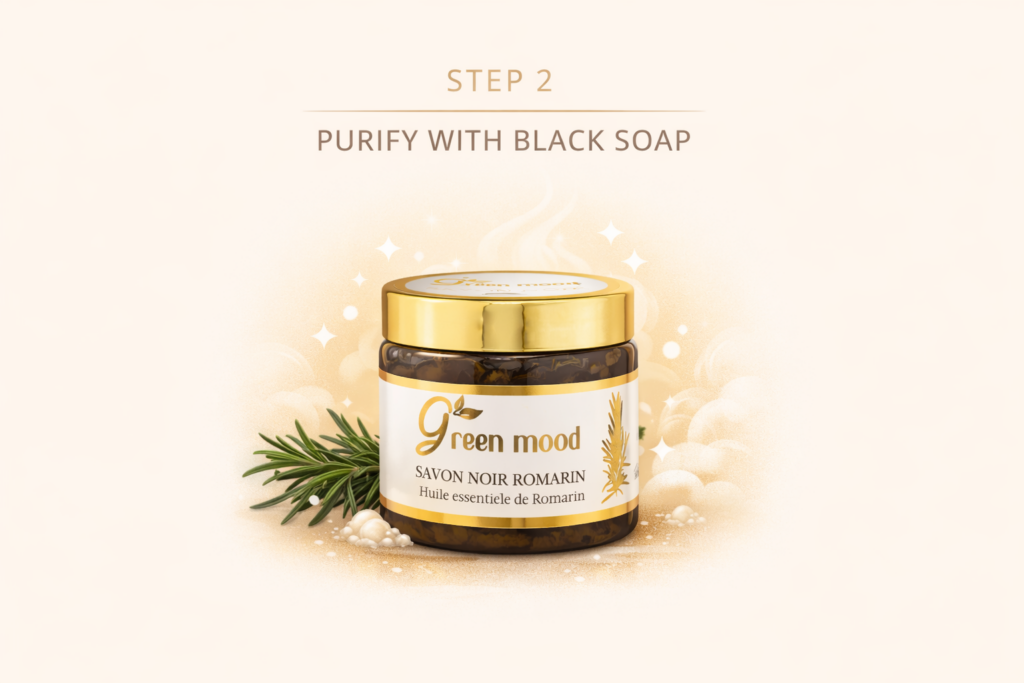
2. Black soap, savon beldi (5 to 10 minutes resting)
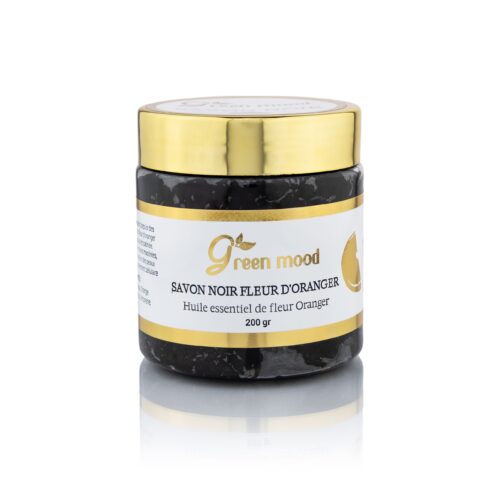
Moroccan black soap is a brown-green paste made from black olives and olive oil saponified with potassium. It barely foams and is never scrubbed in. Take a walnut-sized amount, spread it in a thin film over the whole body on damp skin, avoiding the eye area, and leave it alone. While it rests it loosens dead cells and dissolves oxidised sebum; this is what makes the scrub that follows work.
Rinse it off completely with warm water before the next step. A glove passed over skin that is still soapy slides and lifts nothing.
On the face, black soap is used as a very thin layer for two to three minutes, and never followed by the kessa. Dry or reactive skin can keep black soap for the body only. Eucalyptus, orange blossom or rosemary: the olive base is the same, only the scent changes.
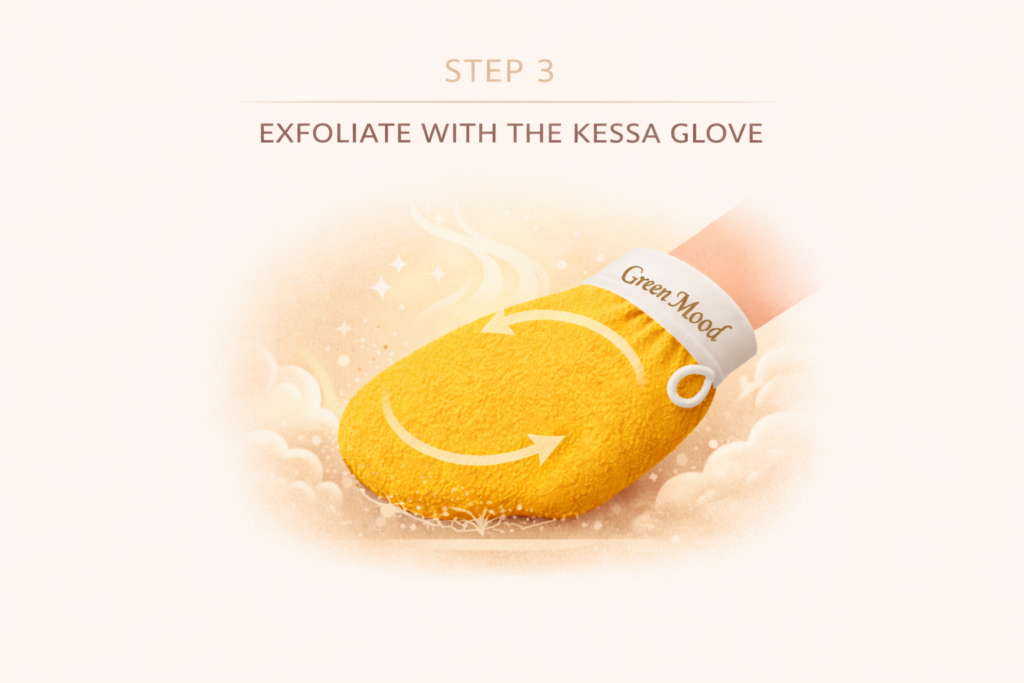
3. The kessa glove (5 to 10 minutes)
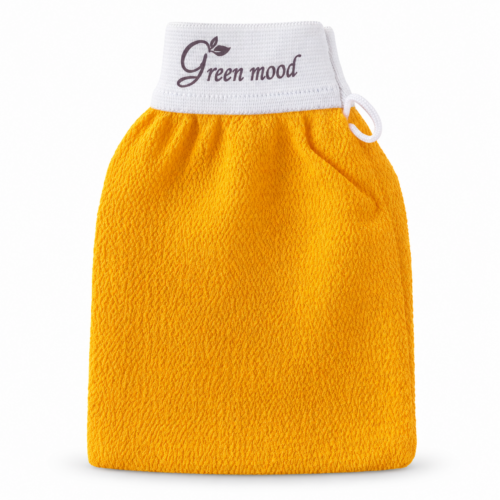
The kessa glove is a rough, crepe-textured fabric mitt that removes what the black soap has loosened. Put it on wet, on damp and rinsed skin, and work in long passes: wrist to shoulder, ankle to thigh, always towards the heart, with medium, even pressure. Small grey rolls will appear on the skin: these are dead cells. When an area stops rolling, move to the next one.
Give extra attention to elbows, knees, heels and the back. Avoid the face, the neck, the chest and any irritated area. A diffuse pinkness that fades within minutes is normal: it is microcirculation stimulated by heat and friction. A burning sensation is not: ease the pressure. Rinse.
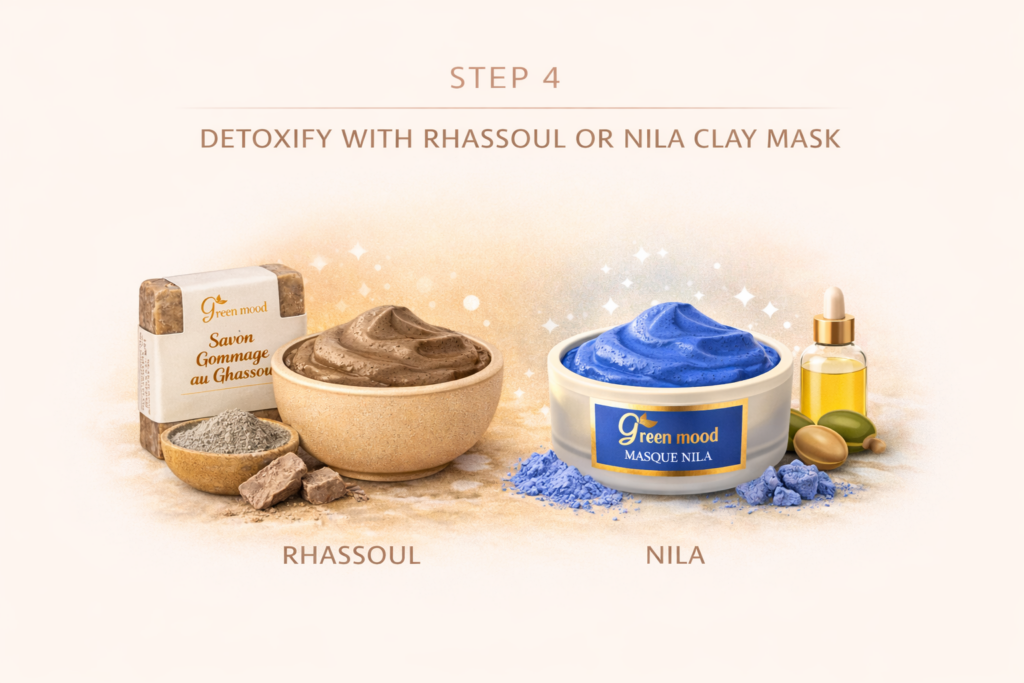
4. The mask: rhassoul or nila (10 minutes)
After the glove the skin is clean and receptive. This is the moment for a mask, on the body, the face or the hair depending on the product.
Rhassoul (also spelled ghassoul) is a clay from the Middle Atlas. Mixed with a little warm water or rose water into a smooth paste, it goes on as a thin layer and rests for about ten minutes. Do not let it dry out completely; a cracking clay pulls at the skin. It absorbs excess sebum, which makes it valuable for the back, for combination skin on the face, and for the roots of the hair.
Nila is not a clay. It is a plant pigment obtained from Indigofera suffruticosa. In Morocco it is used on the face and body for evenness of tone, usually after the scrub. Mixed with a little water, it rests for ten minutes and rinses off with warm water; the blue tint washes away.
Rhassoul to purify, nila for tone: pick one or the other according to how your skin is that day, not both.
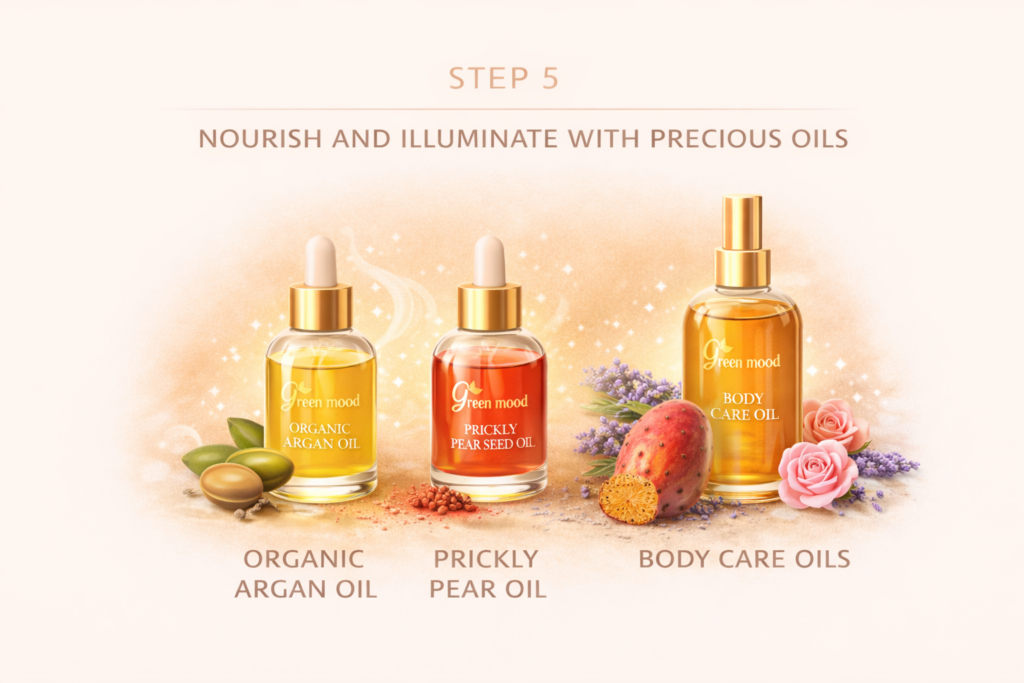
5. Rinse and oil (5 minutes)
Rinse the mask with warm water, then finish with cooler water, the way you would move back to the warm room in a hammam. Pat dry without rubbing and apply oil while the skin is still slightly damp; that is when it spreads best and leaves the least residue.
On the lips and cheeks, Moroccan tradition ends the session with aker fassi, for a rosy note.
After the session
Drink a large glass of water, rest for twenty minutes, and keep freshly exfoliated skin away from direct sun and alcohol-based perfume. The next day the skin is soft but still a little reactive: no extra scrub, no exfoliating actives.
Using the glove on soapy skin. Soap makes the glove slide: nothing rolls, nothing comes off. Black soap is always rinsed before the glove.
Rubbing the black soap. It works by resting, not by scrubbing. Rubbing adds nothing and irritates.
Skipping the heat. Ten minutes of steam is not a comfort; it is the condition for the outer layer to come away without aggression.
Using the kessa on the face. Facial skin is thinner and marks. The face is exfoliated with a gentle scrub made for it, not with the glove.
Doing it too often. Two hammams a week, glove included, weaken the skin barrier. Regularity counts, not frequency.
Forgetting the oil. Exfoliated skin that is not fed feels tight by the evening. The oil is not an option; it is part of the routine.
Buying a black soap that is not one. Real beldi soap is a thick paste, brown-green to dark brown, smelling of olives, with no colourant. A liquid, ink-black or very foamy product is a scented shower gel.
How often, by skin type
Skin type
Frequency
Adjustments
Normal to combination
Once a week
Full routine. Rhassoul on the T-zone, oil everywhere else.
Dry or reactive
Every two weeks
Black soap rested 5 minutes at most, light pressure with the glove, a generous layer of argan oil.
Oily, blemish-prone
Once a week
Rhassoul mask every time. No glove on inflamed areas.
Mature
Once a week
Gentle glove, prickly pear seed oil on the face and décolleté.
When in doubt, space sessions out. Skin that still feels tight or looks pink the next day is telling you the session was too frequent or the glove too firm.
Between sessions: daily body care and the seasons
The hammam is the weekly ritual. Moroccan body care also has a daily layer, and it is short on purpose: cleanse with a mild soap or shower gel, pat dry, and apply a light oil or a hand cream where the skin needs it. In the evening, a richer oil or body milk on damp skin, with attention to elbows, knees and feet. Six to eight minutes a day carries most of the benefit between two hammams.
The routine also moves with the climate. Morocco runs from a humid Atlantic coast to snow in the Atlas and desert air in the south, and the tradition adjusts with it:
Summer. Shorter, cooler hammam sessions. Light scented argan oils rather than rich textures; bath salts rather than a heavy scrub between sessions; rose water kept in the fridge and misted through the day.
Winter. Longer, hotter sessions. Pure argan oil, sometimes warmed between the palms, in place of the lighter scented versions; body milk every day; a second layer of oil on elbows, knees and heels after the kessa.
Dry air. The Moroccan answer is layering on damp skin: a mist of rose water first, then the oil immediately after, so the water is held at the surface while the oil absorbs. One application done this way beats reapplying a single product several times.
Sun. The hammam has never claimed to replace sunscreen. Do not exfoliate on the day of a long exposure, and keep photosensitising scents (citrus, bergamot) off the skin in the morning. After the sun: a cool shower, rose water on damp skin, then a light oil.
What you need, and how to spot the real thing
Four products, no more. Here is how to recognise good ones, because the market is full of “Moroccan” products that are Moroccan in name only.
Black soap (savon beldi). A thick olive paste, brown-green, with olive oil or olive fruit high in the ingredient list and no colourant. A 200 g jar lasts two to three months at one session a week.
Kessa glove. Crepe-textured, rough fabric with solid seams. It softens with use; replace it when it stops rolling the skin, usually after a year or two of weekly sessions.
Rhassoul or nila. Rhassoul as powder or flakes you mix yourself; nila as a fine powder of Indigofera suffruticosa, with no added clay.
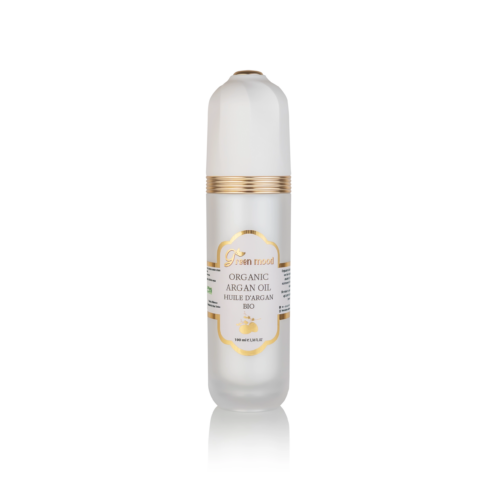
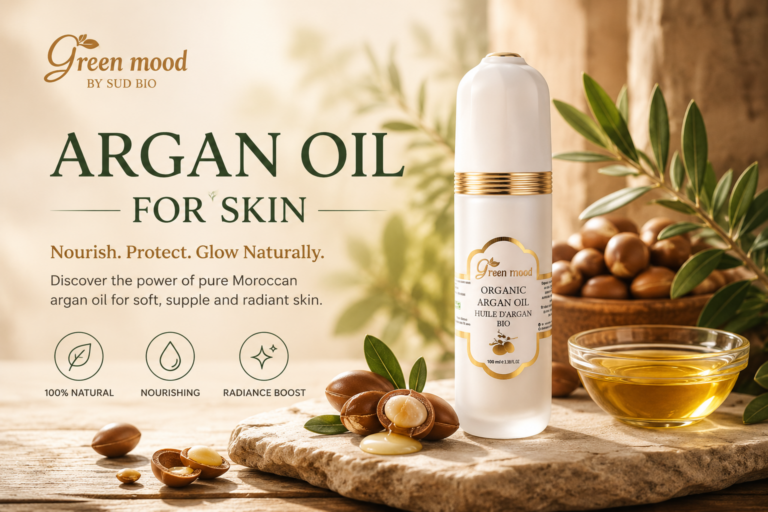
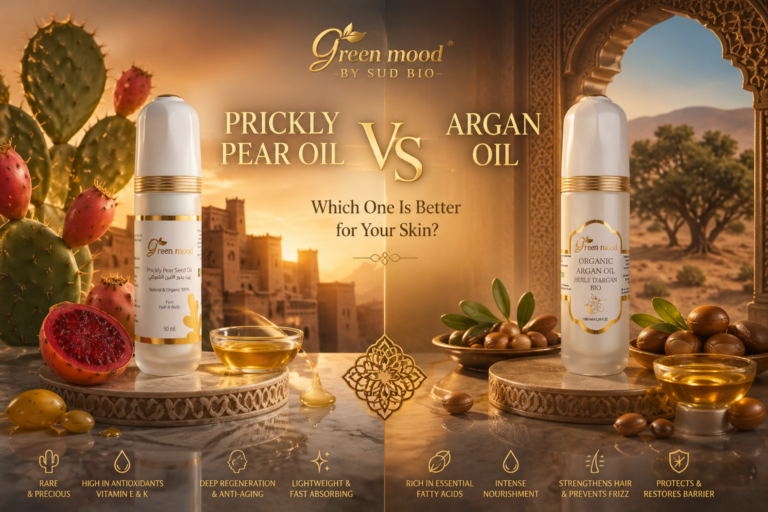
A pure plant oil. Argan for the body, prickly pear seed for the face. Cold-pressed, with Argania spinosa kernel oil or Opuntia ficus-indica seed oil as the first and only ingredient. Our guide on how to recognise pure argan oil lists the checks.
These essentials are sold individually; the Green Mood hammam essentials kit brings the main ones together, in an orange blossom or verbena edition depending on the black soap scent you prefer. Our products are made in Morocco, in our certified production unit in the Souss-Massa region.
Frequently asked questions about the Moroccan hammam routine
How often should you do a Moroccan hammam?
Once a week for normal, combination or oily skin; every two weeks for dry or reactive skin. That is the rhythm of the hammam in Morocco, and it is enough: beyond it, the glove weakens the skin barrier.
Can you do a Moroccan hammam at home without a steam room?
Yes. A very hot shower with the bathroom door closed for ten to fifteen minutes softens the skin enough for black soap and the kessa glove. A steam cabin adds intensity; it does not change the routine.
What is a Moroccan bath?
“Moroccan bath” is the name the ritual goes by in the Gulf and in many spas abroad. It is the same sequence as the hammam described here: humid heat, black soap, kessa glove exfoliation, a rhassoul or nila mask, then oil.
How long does a Moroccan hammam routine take?
At home, 45 to 60 minutes: ten to fifteen minutes of heat, five to ten of black soap resting, five to ten with the glove, ten for the mask, five to rinse and oil. In a public hammam a session often lasts one to two hours.
Can Moroccan black soap be used on the face?
Yes, as a very thin layer for two to three minutes, away from the eye area, and never followed by the kessa glove. Dry or reactive skin can keep it for the body and use a milder cleanser on the face.
Do you rinse the black soap before using the kessa glove?
Yes, completely. The glove must pass over skin that is damp but not soapy; otherwise it slides and removes nothing. This is the most common beginner’s mistake.
Rhassoul or nila: which one after the scrub?
Rhassoul is a clay that absorbs excess sebum: choose it to purify, especially combination to oily skin. Nila is a plant pigment, Indigofera suffruticosa, used for evenness of tone. Alternate from one session to the next according to what your skin needs; do not layer both.
Which oil goes on after the hammam?
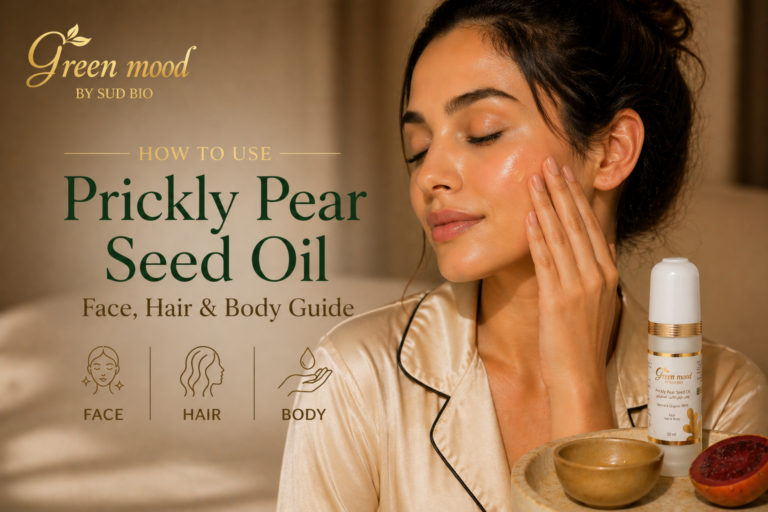
On still slightly damp skin, pure argan oil for the body and prickly pear seed oil for the face. A few drops per area are enough; exfoliated skin absorbs well, so more is not better.
Is the hammam suitable for sensitive skin?
Yes, with adjustments: black soap rested three to five minutes instead of ten, light pressure with the glove, sessions every two weeks, and a generous layer of argan oil to finish. Skip the glove entirely on any irritated area.
Is the hammam advised during pregnancy?
Prolonged heat is generally advised against during pregnancy, and the kessa can be replaced by a gentle scrub. Ask your doctor or midwife before a session.
What is in a complete hammam kit?
The essentials of the routine described here, in one order. The Green Mood hammam essentials kit comes in an orange blossom or verbena edition; the exact contents of each edition are listed on the product page, and the kit is completed with prickly pear seed oil for the face if your skin calls for it.
A hot shower, four products and forty-five minutes a week: that is all the Moroccan hammam asks. The rest is the order of the steps, and keeping to it.
Green Mood makes its skincare in Morocco, in an ISO 22716-certified production unit in the Souss-Massa region, and sells it in seven boutiques, including three airport stores in Casablanca, Agadir and Marrakech.
Complete your ritual with our Body Care and Perfumed Oilsto enhance well-being with every step and rediscover skincare as a sacred ritual of self-love.
Great post. I was checking constantly this blog and I’m
impressed! Extremely helpful info particularly
the last part 🙂 I care for such information a lot.
I was seeking this certain information for a long time.
Thank you and good luck.
Quite interesting skincare routine.
Thank you for the detailed description and information, I highly appreciate this and would like a full kit 👌
Amazing guide and fully explained and detailed, thank you
Thank you, I did order a kit, waiting, thank you for your quick emails and validations xoxo
First of all I want to say excellent blog! I had a quick question which I’d like to
ask if you don’t mind. I was interested to know how you
center yourself and clear your mind before writing.
I’ve had a hard time clearing my mind in getting my thoughts out.
I do enjoy writing however it just seems like the first 10
to 15 minutes are generally wasted simply just trying to figure out how to
begin. Any suggestions or hints? Kudos!
I all the time used to study paragraph in news papers but now as I am a user of internet so from
now I am using net for content, thanks to web.
I absolutely loved this post! The Moroccan Hammam ritual sounds so rejuvenating and grounding. I can’t wait to try out the steps you described and incorporate traditional ingredients into my skincare routine. Thank you for sharing this beautiful aspect of Moroccan culture!
I loved reading about the Moroccan Hammam ritual! It’s fascinating to learn how deeply ingrained these traditional skincare practices are in the culture. I can’t wait to try out some of the techniques at home—especially the use of ghassoul clay. Thanks for sharing such rich insights into this beautiful tradition!



Great post. I was checking constantly this blog and I’m
impressed! Extremely helpful info particularly
the last part 🙂 I care for such information a lot.
I was seeking this certain information for a long time.
Thank you and good luck.
Quite interesting skincare routine.
Thank you for the detailed description and information, I highly appreciate this and would like a full kit 👌
Amazing guide and fully explained and detailed, thank you
Thank you, I did order a kit, waiting, thank you for your quick emails and validations xoxo
First of all I want to say excellent blog! I had a quick question which I’d like to
ask if you don’t mind. I was interested to know how you
center yourself and clear your mind before writing.
I’ve had a hard time clearing my mind in getting my thoughts out.
I do enjoy writing however it just seems like the first 10
to 15 minutes are generally wasted simply just trying to figure out how to
begin. Any suggestions or hints? Kudos!
I all the time used to study paragraph in news papers but now as I am a user of internet so from
now I am using net for content, thanks to web.
I absolutely loved this post! The Moroccan Hammam ritual sounds so rejuvenating and grounding. I can’t wait to try out the steps you described and incorporate traditional ingredients into my skincare routine. Thank you for sharing this beautiful aspect of Moroccan culture!
I loved reading about the Moroccan Hammam ritual! It’s fascinating to learn how deeply ingrained these traditional skincare practices are in the culture. I can’t wait to try out some of the techniques at home—especially the use of ghassoul clay. Thanks for sharing such rich insights into this beautiful tradition!