🌍 Free shipping above 150 € worldwide.


There is a kind of exfoliation that leaves skin raw, tight, and overstimulated — and there is the kind that leaves it calm, luminous, and deeply renewed. The difference is not a matter of effort. It is a matter of approach.
A natural face scrub, chosen and used well, belongs to the second category. It removes what no longer serves the skin — dead cells, surface impurities, the residue of daily life — without disrupting the delicate balance beneath. The result is not stripped skin. It is skin that breathes.
This guide explores what makes a face scrub genuinely gentle, how to exfoliate for your skin type, and why the ingredients and philosophy behind your scrub matter as much as the gesture itself.
In this guide
- What is a natural face scrub?
- The skin barrier — and why you must protect it
- What makes a natural face scrub gentle?
- How often should you exfoliate? A guide by skin type
- Why over-exfoliation damages the skin barrier
- The modern exfoliation philosophy
- When exfoliation is also nourishment
- Integrating a natural face scrub into your ritual
- Frequently asked questions
What is a natural face scrub, and why does it work?
A natural face scrub is a topical treatment that combines exfoliating particles — physical agents that manually remove dead skin cells — with a base of oils, botanical extracts, or clays. Unlike synthetic scrubs, which may rely on microplastics or abrasive mineral powders, natural formulas use ingredients derived from plants, fruits, seeds, or minerals with a known affinity for skin.
The mechanism is straightforward: the surface of the skin constantly renews itself, but dead cells do not always shed evenly. They accumulate, dulling the complexion, clogging pores, and creating uneven texture. Gentle exfoliation clears the way for fresh skin to emerge — and for the skincare products that follow to absorb more effectively.
But the quality of that exfoliation depends entirely on what delivers it.
The skin barrier: what it is, and why you must protect it
Before choosing a scrub, it is worth understanding what you are working around.
The skin barrier — also called the stratum corneum or hydrolipidic film — is a thin, protective layer that keeps moisture in and environmental stressors out. It is not simply skin surface. It is an active system: a matrix of lipids, proteins, and microbiota that regulates hydration, defends against irritants, and signals inflammation when something is wrong.
Aggressive exfoliation breaks this system. Over-scrubbing, using overly coarse particles, or exfoliating too frequently can compromise the barrier — leading to tightness, redness, sensitivity, and paradoxically, more congestion as the skin overproduces sebum in response to perceived damage.
The goal of a well-formulated natural face scrub is the opposite: to support barrier integrity while clearing the surface. The particles should be fine enough to polish, not scratch. The base should be nourishing, not drying. The net effect should be comfort and radiance — not irritation.
What makes a natural face scrub gentle?
Not all natural scrubs are gentle by default. Walnut shells, coarse sea salt, and apricot kernel powders, though natural, can create micro-tears on delicate facial skin. The distinction that matters is not natural versus synthetic — it is particle size, shape, and the medium that carries them.
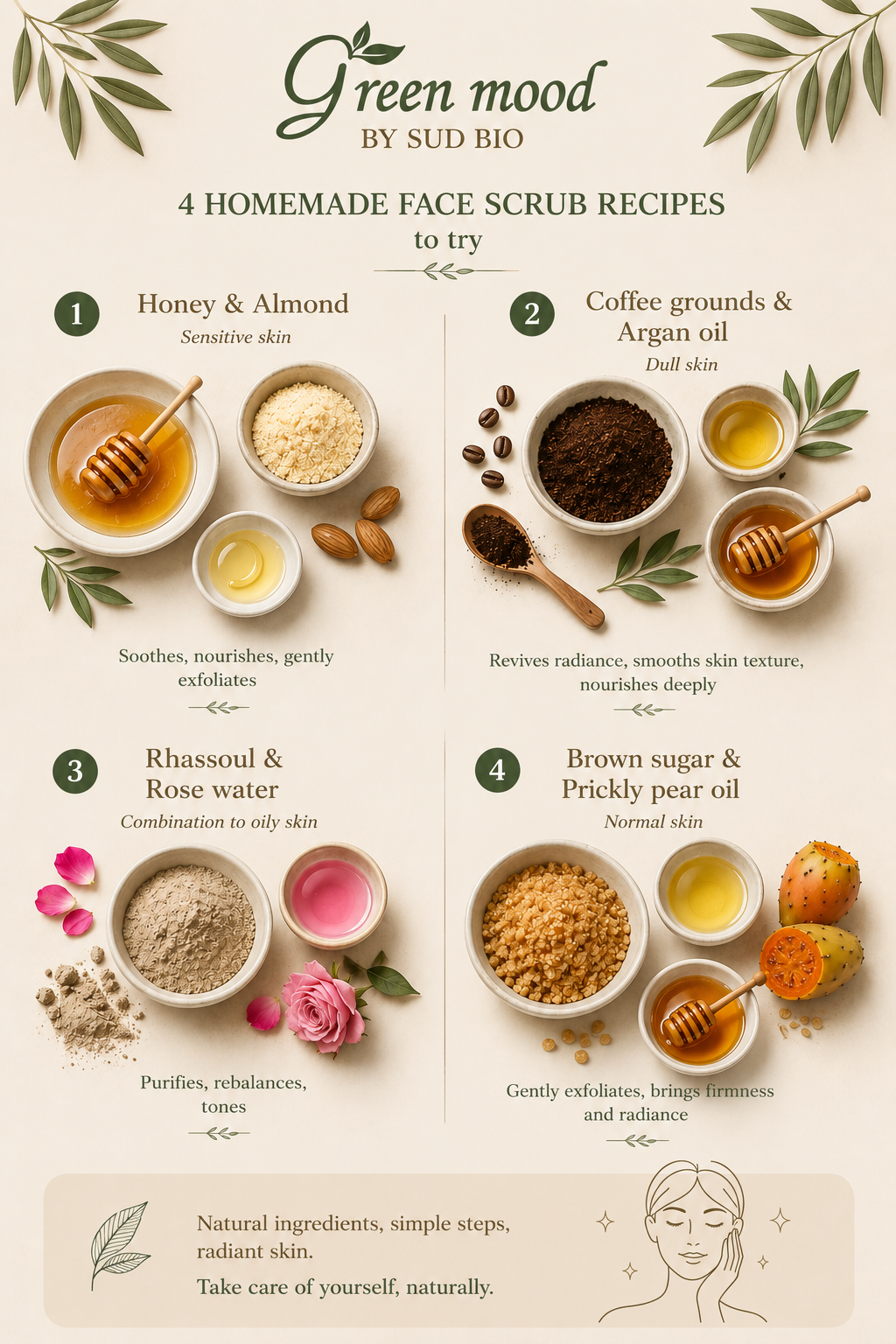
Ingredients to look for in a high-quality natural face scrub:
- Finely milled botanical powders — rice, oatmeal, or fruit-derived particles that polish without scratching.
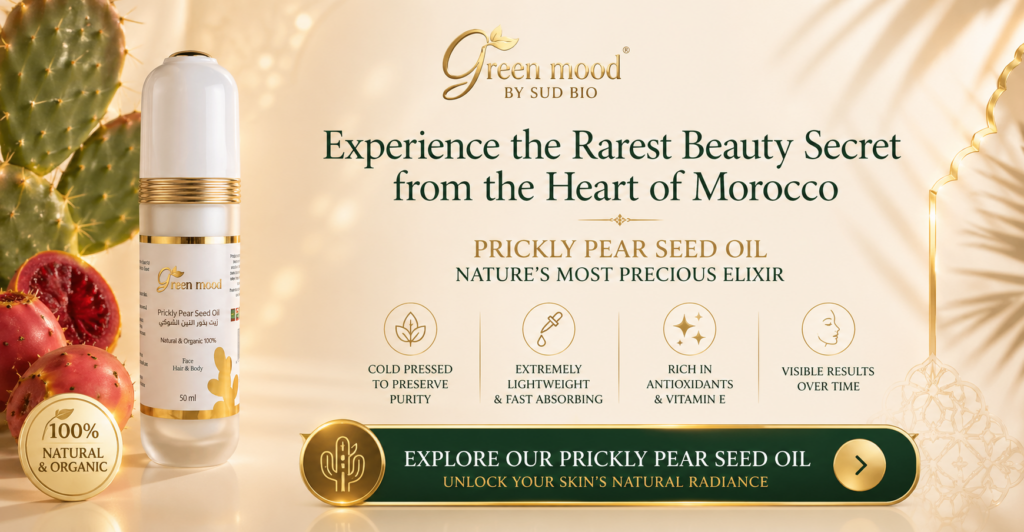
- Nourishing oils — argan, jojoba, prickly pear seed oil — that protect the barrier while delivering active benefits.
- Clays and minerals — rhassoul, kaolin — that refine texture and absorb impurities without stripping.
- Botanical extracts — aloe vera, calendula, rose — that soothe and calm skin during the exfoliation process.
A scrub that combines fine exfoliating particles with a rich oil base does something important: it exfoliates and nourishes simultaneously. The skin is never left unprotected mid-process.
How often should you exfoliate? A guide by skin type
One of the most common exfoliation mistakes is not the wrong product — it is the wrong frequency. More is not better. The skin needs time to renew itself between sessions.
| Skin type | Recommended frequency | Approach |
|---|---|---|
| Sensitive | Once a week at most | Fine particles, rich oil base, no fragrance |
| Oily / Combination | 2 to 3 times per week | Clay-based formulas (rhassoul, kaolin) |
| Normal | 1 to 2 times per week | Balanced exfoliation with mild oils |
| Dry | 1 to 2 times per week | Generous oil component, follow with moisturizer |
| Mature | Once a week | Fine particles + regenerating oils (prickly pear) |
Sensitive skin: once a week at most
Sensitive skin has a lower threshold for stimulation. Its barrier is often already compromised — prone to redness, reactive to changes in temperature or products, prone to tightness after cleansing. For this skin type, exfoliation should be rare and extremely gentle: once a week, with a scrub formulated specifically for comfort. Look for fine particles, a rich oil base, and the absence of fragrance or alcohol.
After exfoliation, sensitive skin benefits from an immediately applied nourishing treatment — a serum, an oil, or a calming cream — to reinforce the barrier that has been gently worked.
Oily and combination skin: two to three times a week
Oily skin tends to tolerate exfoliation better, and benefits from more frequent sessions to clear excess sebum and prevent congestion. Two to three times per week is a reasonable rhythm — but even here, gentleness matters. The goal is to clear the pores, not to strip the skin into producing more oil in response.
Clay-based scrubs work particularly well for oily skin. Rhassoul, a Moroccan mineral clay, absorbs excess sebum while refining pores — addressing the root cause of congestion without aggression.
Normal and dry skin: one to two times a week
Normal skin responds well to a regular but moderate exfoliation rhythm. Dry skin needs the same, but benefits especially from a scrub with a generous oil component — one that hydrates as it refines. After exfoliation, dry skin should always be followed by a moisturizing treatment while the skin is still slightly damp.
Why over-exfoliation damages the skin barrier
Signs of over-exfoliation include persistent redness, a feeling of tightness that does not resolve, increased sensitivity to products that previously caused no reaction, and a paradoxically congested complexion despite regular exfoliation.
When the skin barrier is disrupted, it triggers inflammation and increased sebum production. The skin becomes simultaneously more reactive and more prone to breakouts. The solution is not more exfoliation — it is a rest period, followed by barrier-restoring ingredients like ceramides, fatty acids, and nourishing plant oils.
The modern exfoliation philosophy: less aggression, more intelligence
Contemporary skincare has moved decisively away from the idea that exfoliation should be felt as friction. The most sophisticated formulas do not announce themselves with burning or visible abrasion. They work quietly — polishing, clearing, renewing — while leaving the skin feeling more comfortable than before.
This shift reflects a deeper understanding of skin physiology. The skin does not need to be “forced” into renewal. It needs to be supported in the process it is already doing — with ingredients that clear the way without disrupting what is working.
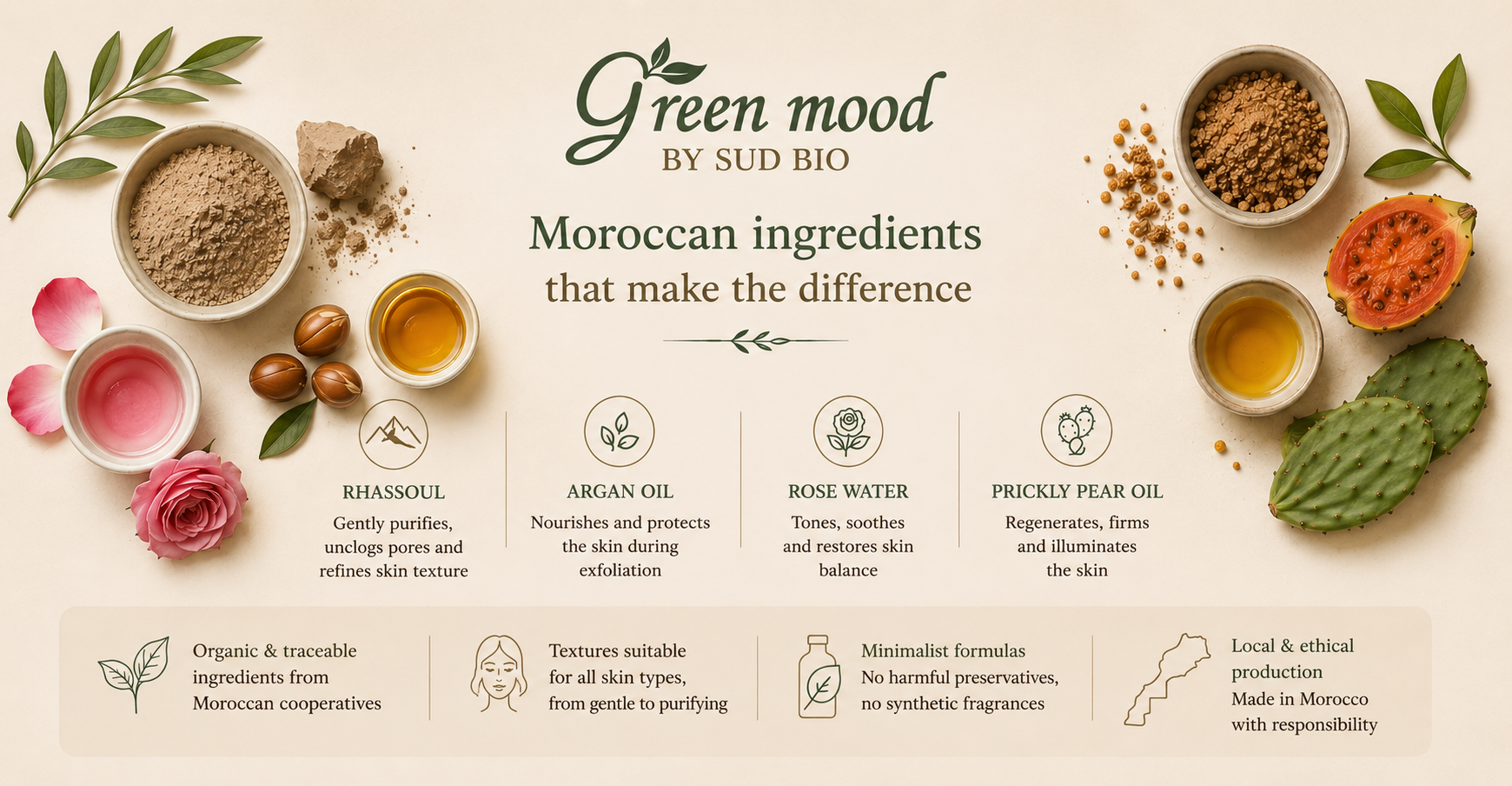
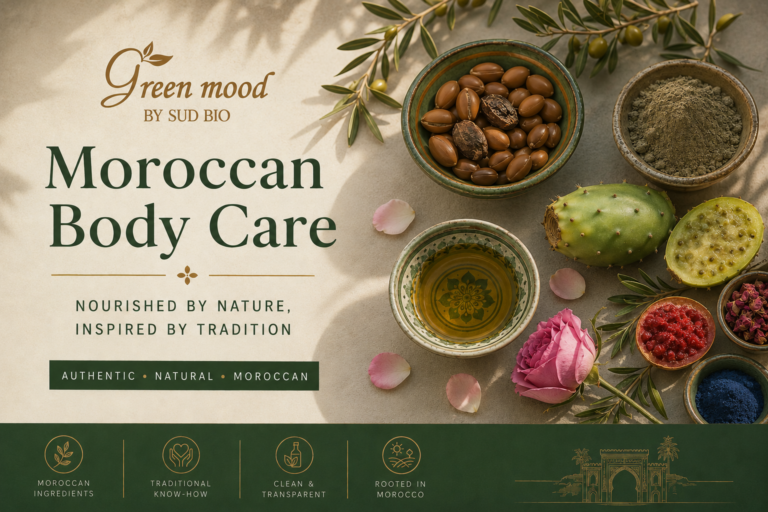
Moroccan skincare traditions understood this long before it became a modern philosophy. The hammam ritual — the combination of steam, black soap, and rhassoul clay — is fundamentally a system of gentle, layered preparation. Each step softens and prepares; the exfoliation that follows is efficient precisely because the skin has been readied for it, not because force is applied.
Explore Green Mood’s Moroccan skincare approach for more on the traditions behind these rituals.
When exfoliation is also nourishment: the role of oil-based scrubs
There is a meaningful difference between a scrub that only exfoliates and one that exfoliates while nourishing.
Most conventional scrubs work in one direction: they remove. The exfoliating particles do their work, the base is rinsed away, and the skin is left waiting for a moisturizer to restore what was lost. The exfoliation and the nourishment are separate steps.
An oil-based scrub collapses that gap. The botanical oils in the formula — argan, prickly pear seed oil, jojoba — are not just a carrier for the exfoliating particles. They are active ingredients in their own right, delivering fatty acids, antioxidants, and lipids to the skin during the exfoliation process. The barrier is being supported at the same moment it is being gently worked.
The sensory experience is also different. An oil-based scrub does not drag or feel abrasive. It glides. The massage feels like care rather than correction. And the skin that emerges — softer, more luminous, and more comfortable — reflects that difference.
This is particularly valuable for skin that has historically been sensitive to exfoliation. When the process is gentle and the nourishment is built in, the skin does not need to recover from the experience. It simply continues forward in better condition.
Integrating a natural face scrub into your skincare ritual
A face scrub works best when it is not isolated. It is the central act in a sequence — one that maximizes both the exfoliation itself and the effectiveness of the steps that follow.
A complete exfoliation ritual:
- Cleanse first. Remove surface makeup and impurities with a gentle cleanser. Exfoliating onto already-clean skin allows the particles to work more precisely.
- Exfoliate on damp skin. Apply the scrub to slightly damp skin, where the particles glide more freely and the oils absorb more easily.
- Massage with intention. Use gentle circular movements. There is no benefit to applying pressure. The particles and the formula do the work.
- Rinse thoroughly. Lukewarm water preserves the hydrolipidic film better than hot.
- Apply a treatment immediately. While the skin is still slightly damp, apply a serum or oil — the barrier is at its most receptive, and absorption is significantly higher.
- Seal with a moisturizer. Complete the ritual by locking in hydration with a face cream suited to your skin type.
One additional consideration: exfoliate in the evening when possible. Freshly exfoliated skin is more sensitive to UV exposure, and the hours of sleep that follow allow the skin’s repair processes to work without interruption. For the complete sequence, see our natural face care routine guide.
Frequently asked questions
How often should I use a natural face scrub?
It depends on your skin type. Sensitive skin: once a week at most. Normal and dry skin: 1 to 2 times per week. Oily and combination skin: 2 to 3 times per week. The goal is to support barrier renewal, not to force it.
Can over-exfoliation actually damage my skin?
Yes. Persistent redness, lasting tightness, new sensitivity, and a paradoxically congested complexion are all signs that the skin barrier has been disrupted. The solution is a rest period followed by barrier-restoring ingredients like fatty acids and nourishing plant oils — not more exfoliation.
What ingredients should I look for in a natural face scrub?
Finely milled botanical powders (rice, oatmeal), nourishing oils (argan, jojoba, prickly pear seed oil), mineral clays (rhassoul, kaolin), and calming extracts (aloe, calendula, rose). Avoid walnut shells, coarse sea salt, and apricot kernel powder — natural does not always mean gentle.
Should I exfoliate in the morning or evening?
Evening is preferable. Freshly exfoliated skin is more sensitive to UV, and the hours of sleep that follow allow the skin’s repair processes to work without interruption.
What is the skin barrier, and why does it matter for exfoliation?
The skin barrier is a thin, active layer that keeps moisture in and stressors out. It regulates hydration, defends against irritants, and signals inflammation. A well-formulated scrub clears the surface without compromising this system — particles fine enough to polish, not scratch, in a nourishing rather than drying base.
What makes an oil-based face scrub different?
Oil-based scrubs exfoliate and nourish simultaneously. The botanical oils in the formula deliver fatty acids, antioxidants, and lipids to the skin during the exfoliation process — so the barrier is supported at the same moment it is being gently worked. The result is comfort rather than recovery.
Conclusion
A natural face scrub should leave the skin feeling refined, comfortable, and balanced — never stripped or overstimulated.
When exfoliation is approached gently, it becomes more than a corrective step. It becomes part of a ritual that supports radiance, texture, and long-term skin comfort.
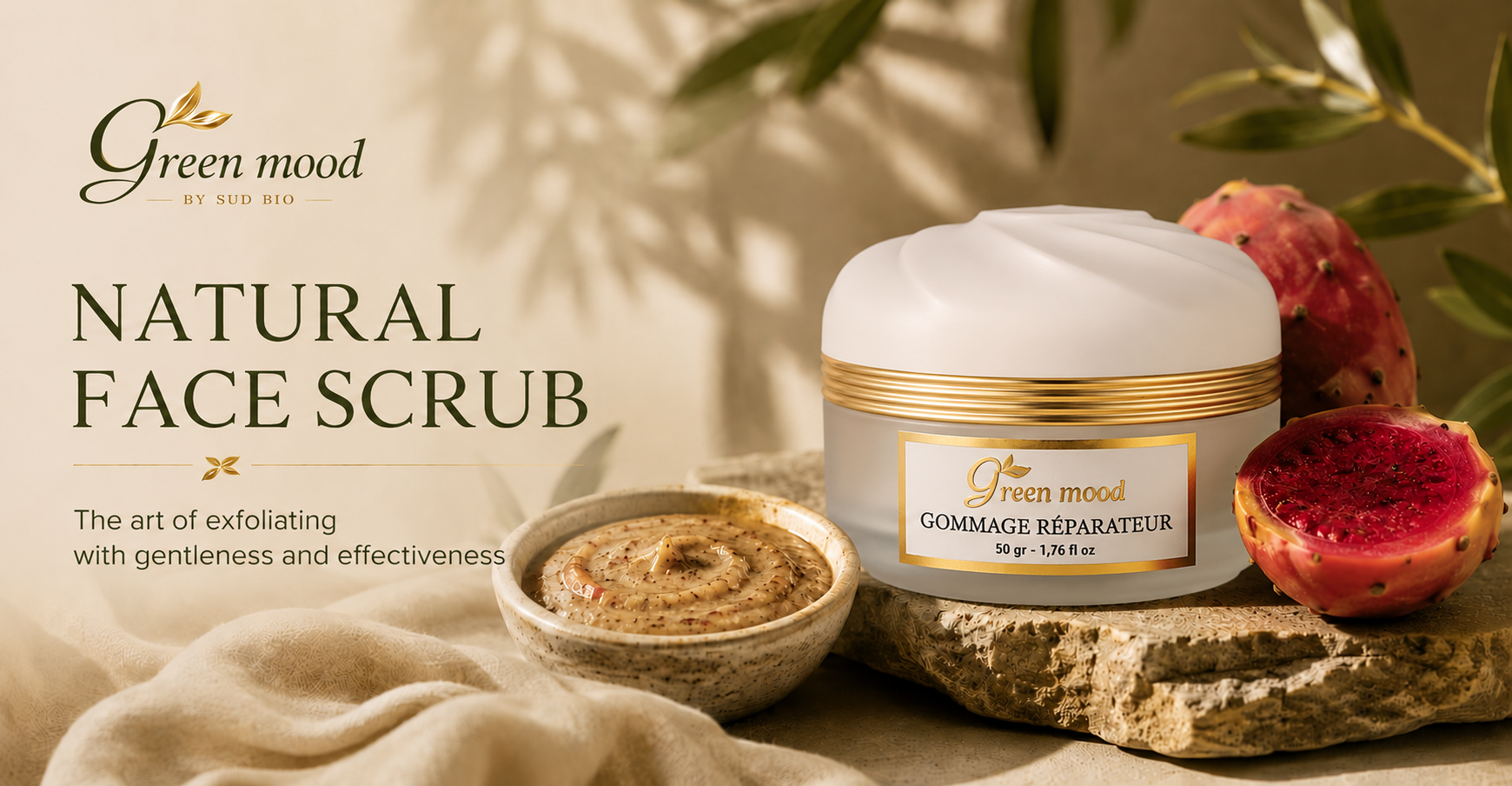
For those seeking an exfoliation experience rooted in Moroccan botanical care, Green Mood’s Prickly Pear Oil Face Scrub combines fine exfoliation with the nourishing properties of prickly pear seed oil and argan oil to create a ritual that is both effective and deeply comforting.
All Green Mood products are formulated in Morocco with certified organic ingredients, free from parabens, silicones, and sulfates. Explore the complete Face Care collection to build a routine grounded in origin, intention, and visible results.